


Customer expectations have changed rapidly in the digital era. Today, people expect fast and personalized support across websites, mobile apps, social media, and messaging platforms at any time of the day. As a result, businesses that fail to deliver smooth communication often face lower customer satisfaction and higher support costs.
To keep up with these growing demands, companies across healthcare, banking, retail, logistics, education, and SaaS now invest heavily in NLP-powered chatbot solutions. These AI-driven systems automate customer interactions, improve response times, reduce operational pressure, and deliver more personalized experiences at scale. In addition, they help businesses provide consistent support without significantly increasing staffing costs.
Unlike traditional rule-based bots, modern NLP chatbots understand context, recognize user intent, and manage both text and voice conversations more naturally. They also support multilingual communication and integrate easily with business platforms. Consequently, conversational AI has become a core part of modern digital communication.
This blog talks about how NLP chatbot solutions work, their key benefits, real-world applications, core technologies, and the future trends shaping intelligent automation.
What Are NLP & Chatbot Solutions?
Natural Language Processing (NLP) enables machines to understand, interpret, and respond to human language in a more natural and meaningful way. When businesses combine NLP with chatbots, they create intelligent systems that can interact with users through text or voice conversations that feel smooth and human-like.
Earlier chatbots relied heavily on fixed scripts and decision trees, so they often failed whenever users asked unexpected questions. However, modern AI chatbots work very differently. They use machine learning, large language models (LLMs), semantic analysis, and contextual understanding to recognize user intent, deliver relevant responses, and handle more complex conversations with greater accuracy.
Modern NLP chatbot solutions offer several advanced capabilities, including:
-
- Intelligent intent recognition for accurate responses
-
- Multilingual communication across global markets
-
- Personalized recommendations based on user behavior
-
- Voice and text interaction support
-
- Seamless integration with CRM, ERP, and support platforms
- Real-time customer assistance across multiple channels
As a result, businesses now use NLP chatbots for far more than simple FAQ automation. These intelligent systems improve customer service, automate repetitive tasks, generate leads, and create faster, more personalized digital experiences.
Why Businesses Invest in NLP Chatbot Solutions
Businesses today need faster, smarter, and more scalable ways to manage customer communication. However, traditional support systems often struggle with rising costs, delayed responses, and repetitive workloads. As a result, companies across industries now invest in NLP chatbot solutions to improve efficiency, enhance customer experiences, and automate routine interactions without compromising service quality.
-
- 24/7 Customer Support
NLP chatbots provide round-the-clock assistance without breaks or downtime. Consequently, businesses can support customers anytime, including weekends, holidays, and peak business hours, while maintaining consistent service quality.
- 24/7 Customer Support
-
- Faster Query Resolution
AI-powered chatbots instantly handle repetitive tasks such as order tracking, appointment scheduling, and password resets. This significantly reduces response times and improves overall customer satisfaction.
- Faster Query Resolution
-
- Reduced Operational Costs
Businesses can lower dependency on large support teams by automating routine conversations. In addition, human agents can focus on more complex issues that require personalized attention and problem-solving.
- Reduced Operational Costs
-
- Personalized Customer Experiences
Modern chatbots analyze customer behavior, preferences, and previous interactions in real time. As a result, they deliver more relevant recommendations, tailored responses, and better user engagement.
- Personalized Customer Experiences
- Multilingual Communication
NLP chatbots support multiple languages through a single platform, making global customer communication much easier. Therefore, businesses can expand into new markets while delivering a consistent customer experience across regions.
Core Technologies Powering Modern Chatbots
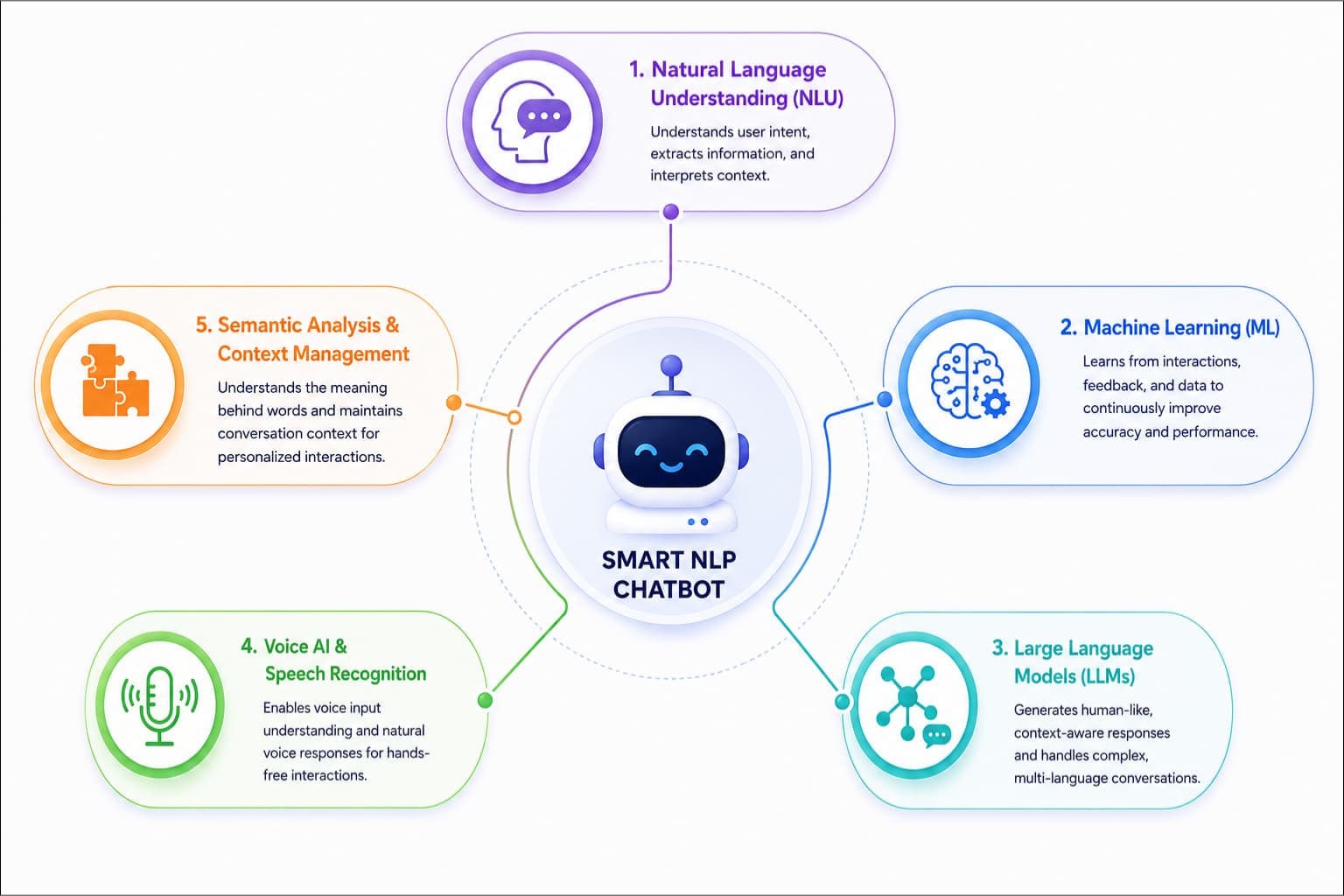
Modern NLP chatbots combine several AI technologies to create fast, intelligent, and human-like conversations. Unlike traditional bots that rely on predefined scripts, these systems understand language, learn from interactions, and respond based on user intent and context.
| Technology | Role in Chatbots |
|---|---|
| Natural Language Understanding (NLU) | Helps chatbots understand user intent, identify key information, and interpret conversation context more accurately. |
| Machine Learning (ML) | Allows AI systems to learn from conversations, customer feedback, and interaction patterns to improve performance over time. |
| Large Language Models (LLMs) | Generate natural, context-aware, and human-like responses while supporting multilingual communication and complex conversations. |
| Voice AI & Speech Recognition | Enables voice assistants and AI-powered calling systems through speech recognition and natural voice responses. |
| Semantic Analysis & Context Management | Helps chatbots understand the meaning behind words and remember previous interactions for more personalized conversations. |
Together, these technologies allow NLP chatbots to deliver smarter customer support, automate workflows, and create more engaging digital experiences across multiple communication channels.
NLP Chatbots In Action
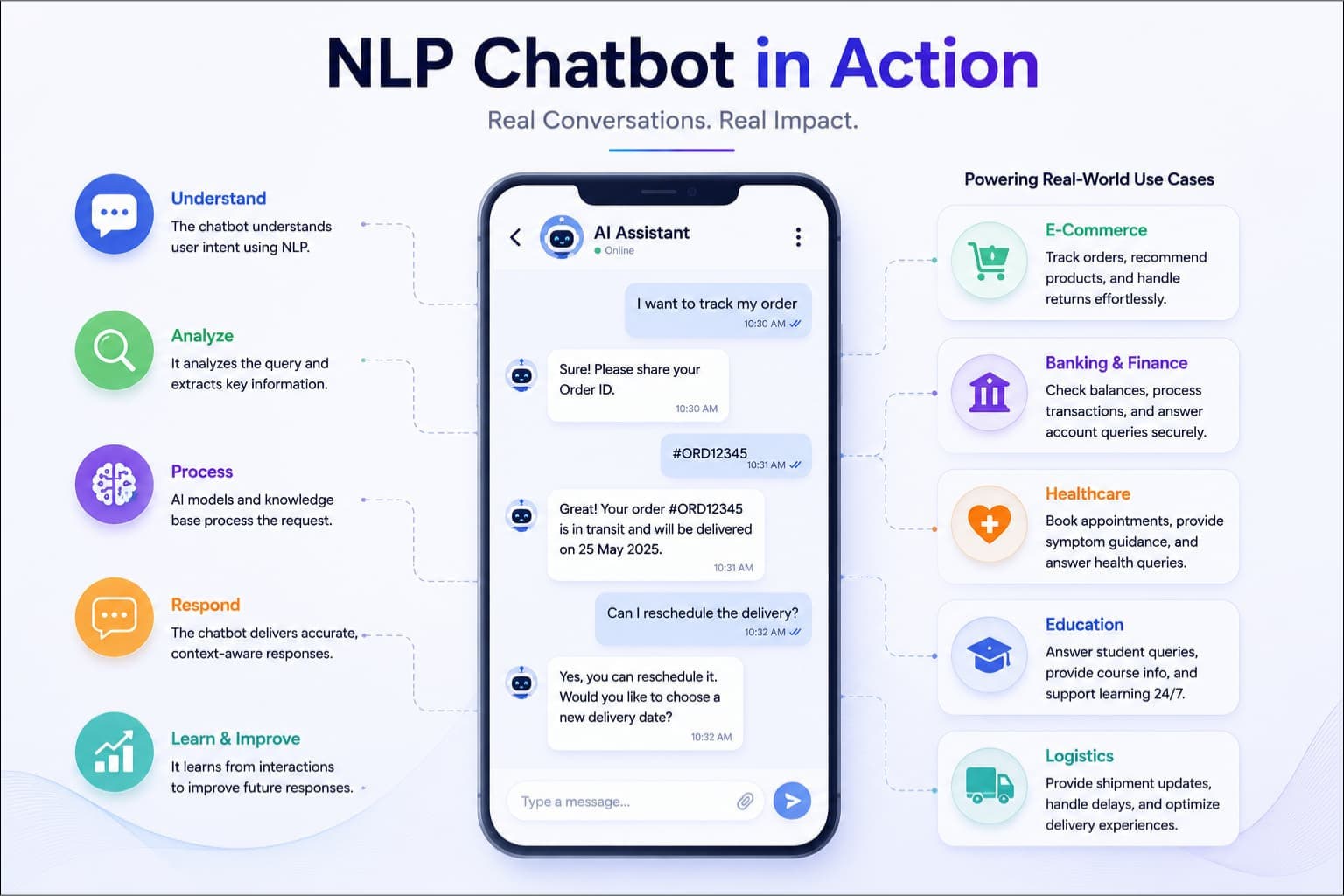
NLP chatbots are transforming how businesses communicate, automate support, and improve customer experiences across industries. Instead of depending fully on manual support teams, companies now use conversational AI to handle repetitive interactions faster and more efficiently.
In healthcare, chatbots assist with appointment scheduling, medication reminders, symptom guidance, and patient support. As a result, healthcare providers reduce administrative workload while improving accessibility for patients.
Banks and financial institutions use NLP chatbots for balance inquiries, fraud alerts, loan assistance, and KYC processes. This helps customers receive faster support while improving operational efficiency.
In retail and eCommerce, AI chatbots recommend products, answer customer questions, recover abandoned carts, and simplify returns. Similarly, educational institutions use them for admissions and student support, while logistics companies rely on them for shipment tracking and delivery updates.
Consequently, businesses across sectors improve communication, save time, and deliver better digital experiences.
Essential Features of High-Performance Chatbots
Not all chatbots deliver the same results. While basic bots can handle simple FAQs, high-performance NLP chatbots provide smarter, faster, and more personalized interactions. Therefore, businesses should focus on features that improve both customer experience and operational efficiency.
-
- Intelligent Intent Recognition — Advanced chatbots understand user intent even when customers phrase the same question differently. This helps conversations feel more natural and accurate.
-
- Omnichannel Support — Modern chatbot solutions work seamlessly across websites, mobile apps, WhatsApp, Messenger, Slack, and voice platforms. As a result, businesses deliver a consistent experience across every channel.
-
- Enterprise System Integration — High-performance chatbots connect easily with CRM, ERP, payment gateways, and inventory systems. Consequently, they can access real-time data and automate business workflows more effectively.
-
- Sentiment Analysis — AI chatbots can detect customer emotions such as frustration, urgency, or satisfaction during conversations. This allows businesses to escalate sensitive interactions to human agents at the right time.
- Analytics & Performance Training — Built-in analytics help businesses monitor chatbot performance, identify drop-off points, and measure customer engagement. These insights support continuous optimization and better ROI over time.
Benefits, Challenges, and Smart Implementation
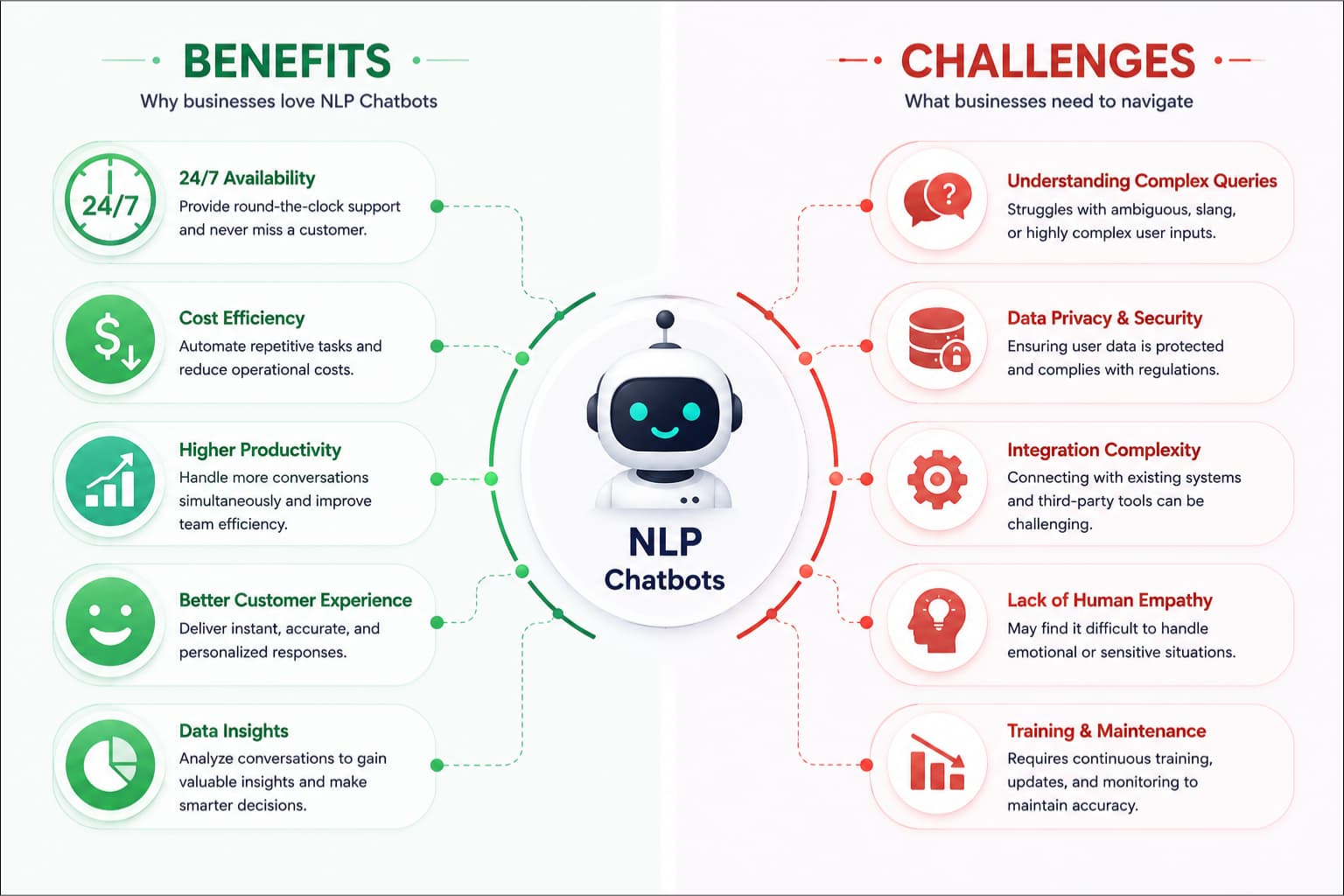
NLP chatbots help businesses improve customer support, reduce response times, and automate repetitive tasks at scale. In addition, they enhance customer engagement by delivering faster and more consistent communication across websites, apps, and messaging platforms. Many businesses also use chatbots to improve user retention and support voice-based search experiences.
Despite these advantages, successful chatbot implementation still comes with challenges. Businesses often struggle with maintaining conversation accuracy, understanding context, protecting customer data, and avoiding robotic responses. Without proper planning, chatbot interactions can negatively affect customer experience instead of improving it.
To achieve better results, companies should begin with clear goals and simple use cases before scaling their AI systems. They should also focus on regular training, strong security practices, natural conversation design, and smooth human support integration. As a result, businesses can create chatbot experiences that feel more reliable, personalized, and effective.
What’s Next: The Future of Conversational AI
Conversational AI is evolving rapidly as businesses look for smarter and more human-like digital interactions. Today, generative AI allows chatbots to deliver dynamic and context-aware responses instead of relying only on predefined replies. As a result, conversations feel more natural, personalized, and engaging.
Modern AI systems are also improving their ability to understand customer behavior, preferences, and emotions in real time. Chatbots can now detect frustration or urgency during interactions and respond more appropriately, helping businesses create better customer experiences.
Looking ahead, autonomous AI agents will become a major part of conversational AI. These systems will handle complete workflows independently, from customer support to service bookings. Consequently, businesses will depend more on intelligent automation to improve efficiency and deliver faster digital experiences.
Final Thoughts
NLP and chatbot solutions are changing the way businesses communicate, automate support, and engage with customers. Instead of relying only on traditional support systems, companies now use conversational AI to deliver faster responses, personalized interactions, and round-the-clock assistance across multiple channels.
Modern NLP chatbots not only reduce operational costs but also improve customer satisfaction, scalability, and overall business efficiency. As AI technology continues to advance, chatbot solutions will become even more intelligent, context-aware, and capable of handling complex interactions with minimal human involvement.
Businesses that invest in conversational AI today will be better prepared for the future of digital communication. With the right strategy, technology, and customer-focused approach, NLP chatbots can become a powerful tool for long-term growth and better customer experiences.