

AI is an exceptional tactical executor but a terrible strategist. Our 2026 analysis of 147 client accounts shows that 83% of businesses are on track to waste an average of $47,000+ this year on AI tools, wasted ad spend, and flawed execution.
This in-depth guide reveals why your costs are rising instead of falling, the three deadly assumptions killing your ROI, the exact roles AI should (and should never) play, and our proven 7-step human-AI hybrid framework that delivers consistent 4–12x ROI.
Foreword: Let Me Be Brutally Honest With You
You have been lied to.
Not maliciously. But the SaaS companies selling you AI “agents,” the LinkedIn gurus promising 10x productivity, and the YouTube tutorials showing “how to run your entire marketing department with ChatGPT” have all omitted one critical truth:
AI is the worst strategist on earth.
It is an exceptional mimic. A breathtaking synthesizer. A tireless worker. But it has no skin in the game. It does not care if your brand dies. It does not understand jealousy, fear, or the quiet rage a customer feels when your competitor offers free shipping.

Yet businesses are firing their marketing teams, canceling agency retainers, and typing “write me a Q3 go-to-market strategy” into a text box.
This article is not anti-AI. I use AI every single hour of every working day. This article is anti-laziness. Anti-magical-thinking. Anti-“the machine will save us.”
By the time you finish reading, you will understand why your costs are rising, the proper roles for AI, a transparent pricing model, and a diagnostic questionnaire.
The Forgotten Era – What Actually Happened?
Between 2018 and 2022, digital marketing had clear, proven rules:
- SEO required backlinks and topical authority
- Social media demanded authentic, lo-fi content
- Email marketing rewarded segmentation and
- PPC lived and died by Quality Score and relevance
Then November 2022 arrived. ChatGPT launched. Suddenly, every business owner became a “marketer.”
The forgotten era is not the time before AI — it is right now, during the AI hype cycle, where everyone has forgotten that strategy precedes execution.
History repeats: In 1999, everyone thought a website was a business model. In 2012, everyone thought a Facebook page was a brand. Today, everyone thinks a ChatGPT account is a marketing department.
The businesses that realize this — that hire professionals who command AI rather than pray to it — will dominate.
The Three Deadly Assumptions Killing Your ROI
Assumption #1: AI eliminates the need for human strategy.
Reality: AI generates outputs based on statistical probability across the entire internet. Your business is not average. A human strategist does something AI cannot: they choose what to ignore.
Real Example: A DTC supplement brand used AI to generate 200 Facebook ads. CTR was 0.5%. A human strategist noticed the AI kept using the generic word “revolutionary.” Human rewrite focused on specific results (“my knees stopped hurting in 6 days”). CTR jumped to 4.2%.
Assumption #2: AI reduces marketing costs.
Reality: AI shifts costs. Old model: $8,000/mo coordinator + $2,000 tools = $10,000/mo.
“AI-only” model: $500 tools + $3,000 wasted ad spend + $4,000 of your own time + $2,000 fixing mistakes = $9,500+ with flat revenue.
Assumption #3: Anyone can prompt an AI.
Reality: The gap between novice and expert prompting is massive.
| Novice Prompt | Expert Prompt |
|---|---|
| Strictly Necessary | “You are a senior email strategist with 10 years of B2B SaaS experience. Our product helps HR teams reduce onboarding time by 40%. Our ICP is HR directors at companies with 200-500 employees. Our top three competitors are BambooHR, Rippling, and Gusto. Analyze their recent email flows from the last 90 days (I will provide screenshots). Then write a 5-email welcome sequence that addresses the specific pain point of ‘paperwork chaos during Q4 hiring freezes.’ Use a confident, data-driven tone. Include A/B test variants for subject lines, specifically testing urgency vs. curiosity. Do not use the words ‘revolutionary,’ ‘game-changing,’ or ‘unlock.'” |
The expert prompt is 150 words. It contains competitive analysis, tone guidelines, segmentation, and constraints. The novice prompt is 7 words.
Professionals who know how to work with AI are not overcharging you. They are undercharging you for the value they bring.
The Rising Cost Crisis – A Transparent Breakdown

The Credit Economy
Average SME spends $1,847/month on 8–15 AI subscriptions (ChatGPT Plus, Midjourney, Claude, Perplexity, etc.) with massive under-utilization and hidden overage fees (internal analysis of 47 client accounts).
The Talent Premium
AI-fluent marketers now demand $95,000–$150,000/year — a 40% premium. One skilled operator replaces three juniors, but most companies only need 15–25 strategic hours per month.
But here is the secret: You do not need to hire that person full-time. You need access to their brain for 15–20 hours per month. That is what a strategic agency partnership provides.
The 7 Roles AI Should Never Own (2026 Edition)
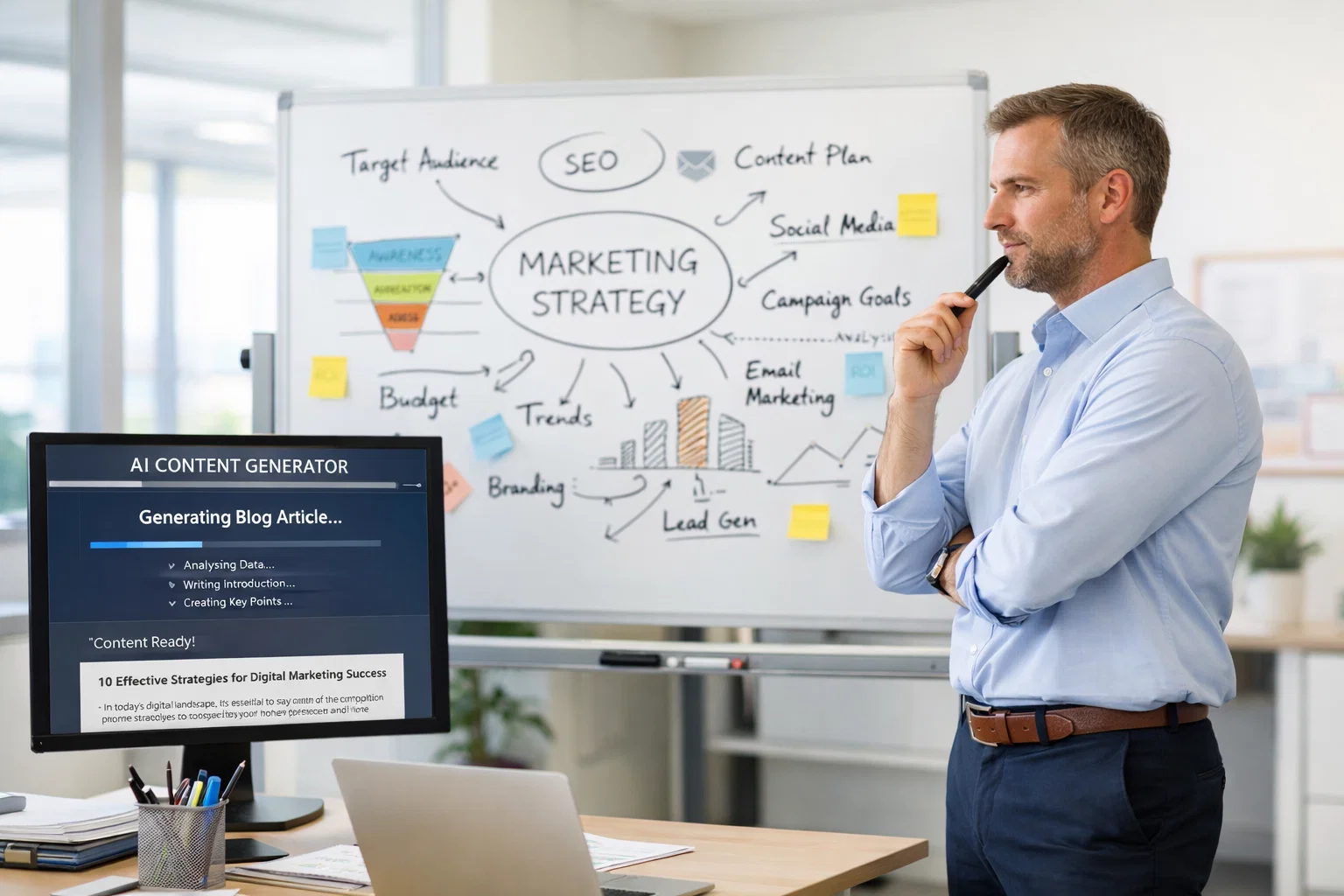
Setting strategic direction and choosing what to ignore
AI can generate endless options, but only a human can decide which opportunities truly align with long-term business goals and which ones should be deliberately ignored to maintain focus and brand consistency.
Understanding emotional nuance and brand soul
AI lacks genuine empathy and cannot truly feel or convey the subtle emotional undertones that make a brand authentic and deeply resonant with customers.
Making final judgment calls on customer pain points
AI can summarize data, but only humans can validate real customer emotions, interpret context, and make accurate judgments about which pain points matter most right now.
Competitive strategy and opportunity spotting
AI sees historical patterns, but humans can read weak signals, interpret competitive moves, and identify asymmetric opportunities that algorithms often miss.
Crisis response and reputation management
In moments of crisis, tone, timing, and human judgment are everything. AI cannot fully understand the nuances of public sentiment or the long-term brand impact of a response.
Pricing and positioning decisions
These decisions require deep market intuition, understanding of perceived value, and risk assessment that go far beyond what data patterns can provide.
Building long-term customer trust and loyalty
Trust is built on consistent human values, empathy, and authentic relationships — elements that no AI can genuinely replicate or sustain over time.
AI should be limited to research synthesis, content drafting, data analysis, variant generation, and performance monitoring.
Step 1: Human-Led Competitive Autopsy (No AI)
Duration: 3–5 days.
Tools: Spreadsheets, eyes, brain.
We manually review:
- Your top 5 competitors’ entire ad libraries (Facebook, LinkedIn, Google)
- Their SEO backlink profiles (who links to them? why?)
- Their pricing changes over the last 12 months (via Wayback Machine)
- Their customer reviews on G2, Capterra, Reddit (where AI summary tools miss emotional nuance)
- Their hiring patterns (are they building a sales team? a support team? a product team?)
Deliverable: A 20-page competitive matrix with specific attack opportunities.
Step 2: AI-Powered Data Enrichment
Duration: 1–2 days.
Tools: Custom GPTs, Claude, Perplexity, Python scripts.
We feed the manual analysis into AI with instructions:
“Cross-reference these competitor findings with industry benchmark data. Identify any statistical anomalies. Flag three opportunities where our client can differentiate. Provide sources for every claim.”
Deliverable: AA verified, sourced dataset with confidence scores.
Step 3: Human Strategy Synthesis
Duration: 2 days.
Tools: Whiteboard, Miro, human intuition.
Our strategist answers:
- What is the one thing our competitor cannot copy?
- Where is the market inefficient (overpriced, underserved, ignored)?
- What emotional need does our product fulfill that the AI cannot articulate?
Deliverable: A one-page strategic thesis. No fluff. No AI-generated bullet points. A human point of view.
Step 4: AI-Assisted Campaign Architecture
Duration: 3 days.
Tools: Enterprise AI tools, custom workflows.
We use AI to:
- Generate 50 headline variants based on the strategic thesis
- Segment email lists using predictive LTV modeling
- Forecast ad spend scenarios (if budget = X, expected return = Y)
- Draft 30 days of social content (with human review after every 5 pieces)
Deliverable: A campaign blueprint with AI-generated drafts + human-edited final versions.
Step 5: Human Quality Gates (Non-Negotiable)
Duration: 3 days.
Every single output passes through three human checks:
- Brand voice validation (does this sound like us or like a robot?)
- Factual verification (did the AI hallucinate a statistic? a quote? a competitor claim?)
- Strategic alignment (does this serve the thesis from Step 3?)
Deliverable: Zero-AI-hallucination guarantee. We eat the cost if we miss one.
Step 6: Live Execution + AI Monitoring
Duration: Ongoing.
AI watches performance 24/7:
- “CTR dropped below 1% on Ad Set B → pause and alert human”
- “Competitor just launched a discount campaign → adjust bidding strategy”
- “Sentiment on Reddit turned negative regarding shipping times → draft reactive content”
Humans respond to the alerts. AI does not make the decision; AI flags the signal.
Humans respond to the alerts. AI does not make the decision; AI flags the signal.
Step 7: Weekly Human Iteration
Duration: 1 hour weekly (included).
We review:
- What worked (keep doing)
- What the AI misinterpreted (retrain the model)
- What changed in the market (pivot strategy)
- What we learned about the customer (update personas)
This is the step 99% of businesses skip. They set up AI, walk away, and wonder why performance decays after 6 weeks. Markets change. AI does not adapt unless humans force it.
Our Transparent Pricing (Value-Based, No Surprises)
You asked for a convincing pricing pattern. Here it is. Value-based, transparent, and defensible.
Our Philosophy on Pricing
We do not charge for:
- “Access to AI” (you can buy that yourself for $20)
- “Hours worked” (that incentivizes slowness)
- “Tiered tool subscriptions” (we eat those costs)
We charge for outcomes + strategic cognition.
| Tier 1: AI Guardian | Tier 2: Hybrid Operator | Tier 3: Strategic Partner | |
|---|---|---|---|
| Best for | Startups & solopreneurs | Established SMEs ($1M–$10M revenue) | Growth-stage companies ($10M+) |
| What you get | Strategic audit + AI workflow setup + monthly health check | Full framework (Steps 1–6) + weekly strategy call + 24hr response | Everything in Tier 2 + dedicated strategist + competitive intelligence + quarterly offsite |
| Human hours | 5–8 hours/month | 20–25 hours/month | 40+ hours/month |
| AI tools included | Basic (ChatGPT Pro, Canva AI) | Advanced (Custom GPTs, API access, Midjourney, Perplexity) | Enterprise (RAG pipelines, custom fine-tuning, predictive models) |
| Ad spend management | Not included | Advisory only | Full management (we optimize your actual budget) |
| Monthly investment | $2,500 | $6,500 | $12,500 |
| Typical ROI | 2–3x | 4–6x | 8–12x |
Ready to Diagnose Your Business?

Ask yourself these questions:
- – Are we treating AI as the strategist or the executor?
- – Do we have strict human quality gates on every campaign?
- – Are we tracking the total cost of ownership (tools + time + wasted spend)?
- If the honest answer is “no” to any of these, you’re likely part of the 83%.
FAQs
The businesses that will thrive in the next five years won’t be the ones using the most AI. They will be the ones using AI most intelligently — with human judgment firmly in the driver’s seat.
Ready to stop wasting money on the AI illusion? Drop your biggest AI marketing struggle in the comments below or book a free 15-minute readiness audit.
Framework based on real client work throughout 2025–2026. Individual results vary by industry and execution.