
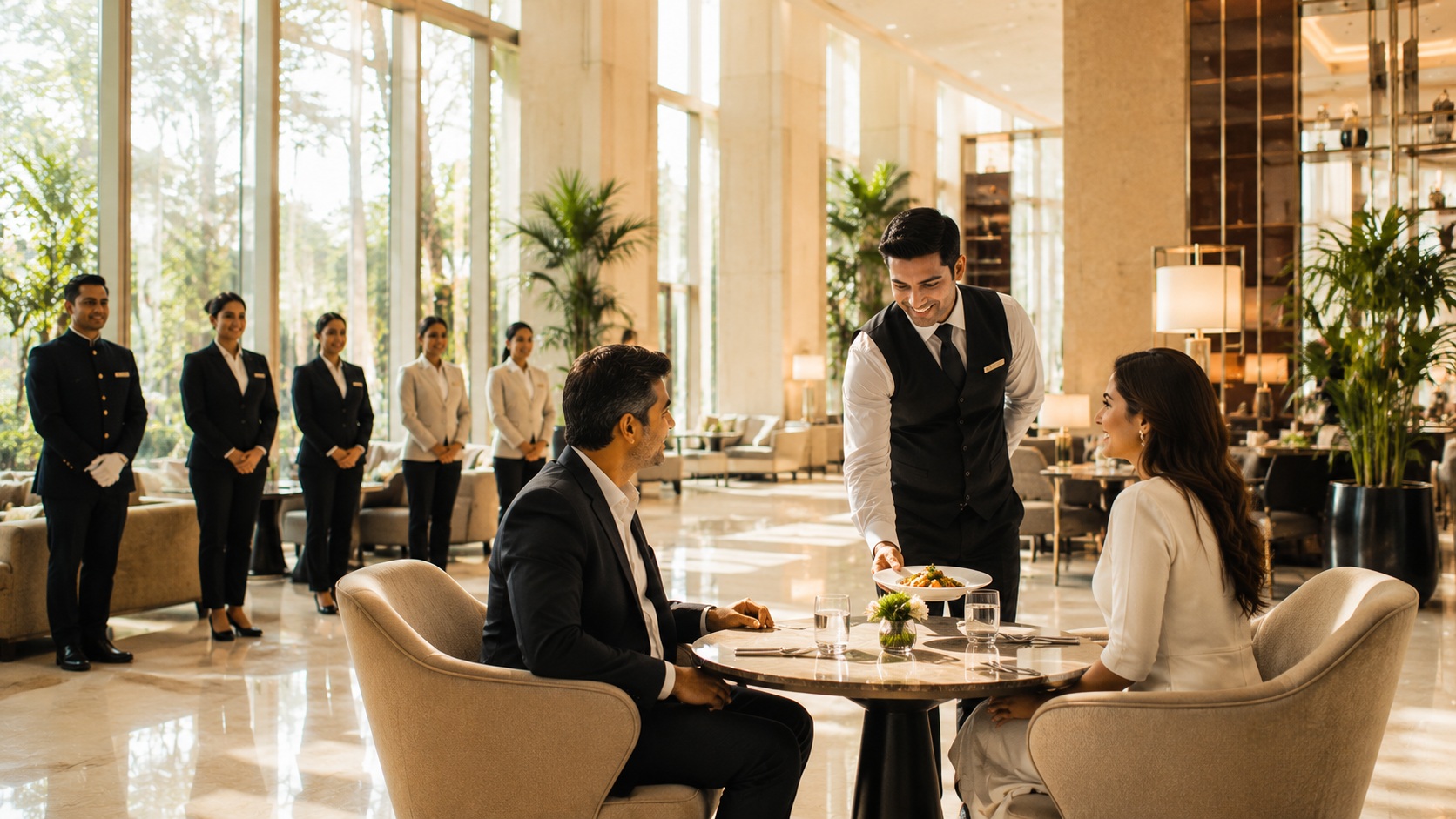

As a culture transformation consultant, we helped a luxury hospitality group increase employee engagement by 24% and guest satisfaction consistency by 18% in an 18-week engagement — after doubling its international footprint in 4 years left culture diluted rather than broken.
Growth Didn't Break the Culture. It Outpaced It.
Over 4 years, this luxury hospitality group doubled its international footprint, entered several premium tourism markets, and recruited hundreds of new employees across hotels, guest experience teams and regional operations. Commercially, the expansion exceeded expectations.
Yet guest satisfaction scores began varying significantly between regions, employee engagement became increasingly inconsistent, and senior leaders noticed a recurring concern during internal listening sessions: employees could describe the company’s values. They struggled to describe how those values influenced everyday decisions. The organisation hadn’t lost its culture. It had diluted it.

Culture Was Strongest Wherever Leaders Actually Demonstrated It
Working alongside executive leadership, regional directors and operational managers, we examined how leadership decisions influenced recruitment, onboarding, performance management, customer service and team development across multiple countries.
One finding became immediately apparent: culture was strongest where leaders actively demonstrated organisational values through visible decisions. Where leadership became more operationally focused, culture gradually became interpreted differently by individual teams. The organisation did not require new values. It required more consistent leadership.
Embedding Culture Into Leadership Systems, Not Communications Campaigns
Together with the executive team, we designed a leadership framework that integrated organisational values into every significant people process.
- Redesigned leadership development programmes around behavioural expectations rather than management theory.
- Incorporated leadership principles into performance conversations alongside commercial objectives.
- Weighted recruitment and onboarding toward cultural alignment as well as technical capability, with regional leaders coached to strengthen consistency across international markets.

Our Methodology
This engagement followed our five-phase culture leadership framework — Discovery & Culture Diagnostic, Leadership Behaviour Mapping, Values Integration Design, Coaching & Rollout, and Validation & Handover — applied across multiple countries over 18 weeks.
Five named deliverables anchored the transformation:
- Culture Consistency Diagnostic — comparing how organisational values were interpreted and applied region by region.
- Leadership Behaviour Map — identifying where leaders actively demonstrated values through visible decisions versus where culture drifted.
- Values-Integrated People Process Framework — embedding cultural expectations into recruitment, onboarding, performance and development.
- Regional Leadership Coaching Standard — establishing common leadership standards while allowing appropriate regional flexibility.
- Leadership Culture Scorecard — structured metrics giving executives ongoing visibility into culture, not just annual employee surveys.
Each deliverable fed directly into how leaders were recruited, coached and evaluated, so cultural consistency traced back to documented leadership behaviour rather than a values statement on a wall.
What Changed in the First 12 Months
Within twelve months:
- Employee engagement increased by approximately 24% across newly established regions.
- Guest satisfaction consistency improved by roughly 18% throughout the organisation.
- Regional managers demonstrated greater confidence making decisions aligned with organisational values, without limiting local innovation.
- Executive leadership gained ongoing visibility into organisational culture through structured leadership metrics.
- Guests described the organisation in remarkably similar terms across locations — not because every property looked identical, but because every leader represented the same principles.
Culture had become scalable.

Our Perspective
Culture is often described as an organisational asset. In reality, it is a leadership responsibility.
Employees learn culture less from what organisations publish than from what leaders repeatedly reward, tolerate and demonstrate.
That risk compounds specifically during rapid growth: a 2026 Forbes Coaches Council analysis of company culture trends found that as organisations move faster, it becomes easy for teams to appear aligned on the surface while pulling in different directions — and that real alignment only shows up in behaviour, which is precisely why this engagement focused on leadership behaviour rather than communications campaigns.
Frequently Asked Questions
How did a commercially successful expansion end up diluting the company’s culture?
The organisation doubled its international footprint and recruited hundreds of new employees in 4 years — growth that exceeded commercial expectations. But new employees joined faster than existing employees could influence them, and without intentional leadership, culture gradually became interpreted differently by individual regional teams rather than experienced consistently.
Employees could still describe the company’s values — so what was actually missing?
Employees knew the values as statements. What varied was how those values translated into everyday decisions — recruitment, performance conversations, customer service moments. Culture was strongest specifically where leaders visibly demonstrated values through decisions, and weaker wherever leadership became purely operationally focused.
Why fix leadership behaviour instead of rewriting the values or launching a communications campaign?
The organisation had already tried the standard response to cultural inconsistency — clear value statements were in place. What was missing wasn’t awareness, it was consistent behaviour. Rewriting values or running another campaign would have repeated an approach that improves awareness without improving how leaders actually act.
What was the measurable outcome of the culture transformation engagement?
Within twelve months: employee engagement increased by approximately 24% across newly established regions, and guest satisfaction consistency improved by roughly 18% throughout the organisation.
What methodology did we use to embed culture into leadership across multiple countries?
We applied a five-phase culture leadership framework — Discovery & Culture Diagnostic, Leadership Behaviour Mapping, Values Integration Design, Coaching & Rollout, and Validation & Handover — across hotels, guest experience teams and regional operations in multiple countries over 18 weeks.
Work With a Culture Transformation Consultant
Every growing organisation eventually reaches the point where culture can no longer spread organically. That’s when leadership becomes the organisation’s most important communication channel.