
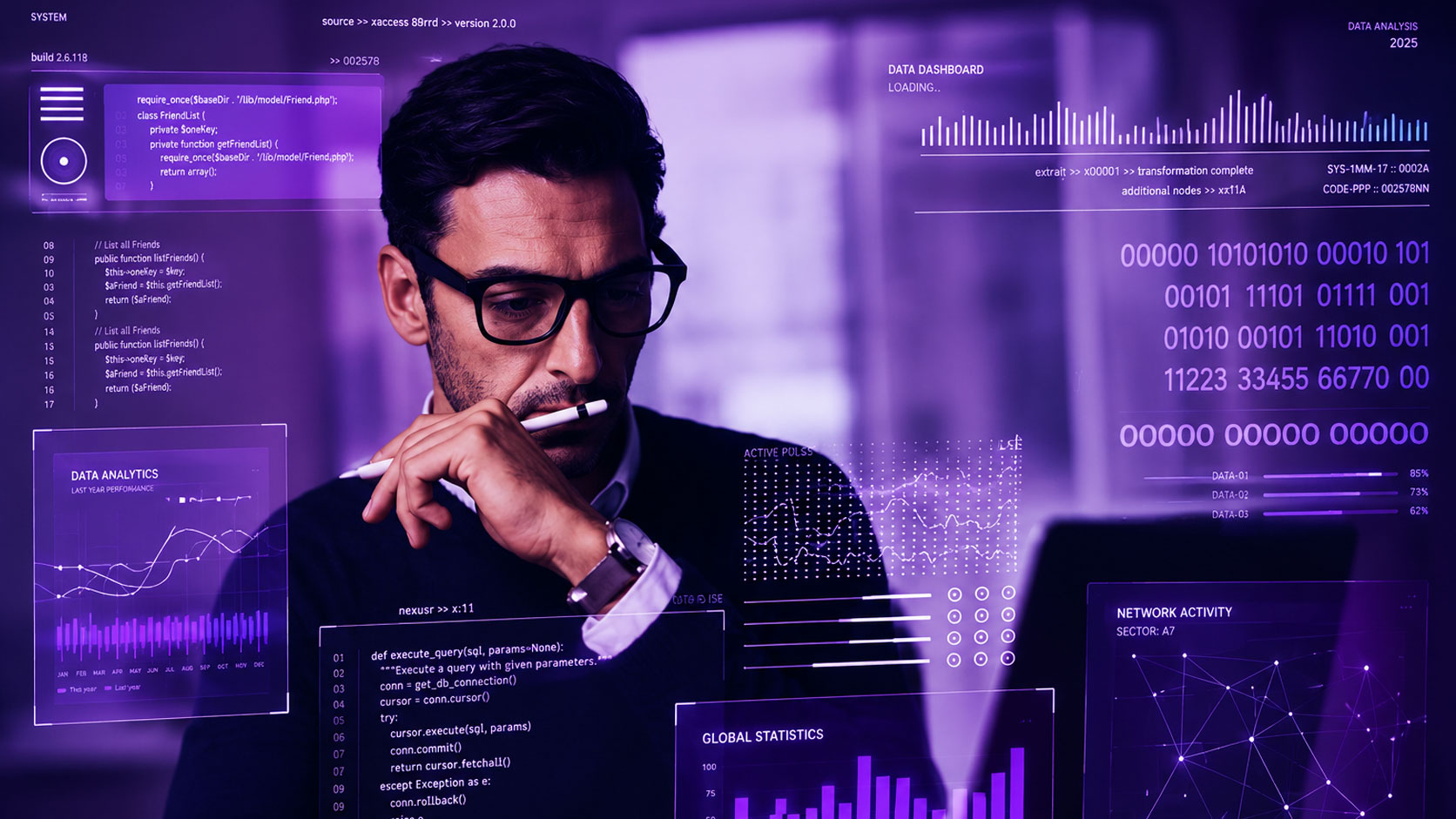

As an AI Business Digital Twin consultant, we helped a multi-site retail and distribution business speed strategic planning cycles by 43% and improve forecasting accuracy across commercial operations by 31% in a 28-week engagement — by giving leadership a living model of the business they could test decisions against before making them.
Historical Dashboards Explained the Past. Leadership Needed the Future.
Every strategic decision at this business carried consequences — opening new locations, adjusting pricing, changing inventory policies, expanding into new markets. Leadership relied on historical dashboards and financial reports to estimate future outcomes, but that information explained what had happened. It couldn’t reliably demonstrate what was likely to happen next.
Different departments developed their own forecasts using different assumptions, often producing conflicting recommendations. Executives weren’t short of data. They were short of certainty.
AI Needed to Simulate Possibilities, Not Just Report Performance
The project began by identifying the operational relationships driving business performance — sales, inventory, staffing, marketing, supply chain, customer demand and regional performance — and mapping how changes in one area influenced every other part of the organisation.
The objective wasn’t prediction alone. It was experimentation — leadership wanted to ask what happens if inventory increases by 15%, or how opening three new locations would affect profitability. The platform became a strategic laboratory rather than another reporting system.
Engineering a Business Digital Twin
The solution integrated ERP, CRM, finance, HR, inventory, customer analytics and operational systems into one continuously synchronised business model.
- Artificial intelligence identified relationships between operational variables and generated predictive simulations using historical performance, external market signals and real-time business activity.
- Executives could model different business scenarios through intuitive planning interfaces without requiring specialist data science expertise.
- Scenario comparisons highlighted opportunities, risks and confidence levels while explainable AI ensured every recommendation remained transparent and traceable, with operational assumptions adjustable dynamically during planning workshops.
Our Methodology
This engagement followed our five-phase business simulation framework — Discovery & Operational Relationship Mapping, Data Integration & Model Design, Simulation Engine Engineering, Scenario Planning Interface Rollout, and Validation & Handover — applied across sales, inventory, staffing and finance over 28 weeks.
Five named deliverables anchored the platform:
- Cross-Departmental Forecasting Consistency Diagnostic — identifying where different departments' conflicting assumptions were producing inconsistent forecasts.
- Connected Enterprise Data Model — integrating ERP, CRM, HR, inventory and operational systems into one continuously synchronised model.
- Predictive Simulation Engine — generating scenario outcomes from historical performance, market signals and live business activity.
- Scenario Comparison & Confidence Interface — letting executives explore multiple strategic paths without specialist data science expertise.
- Explainable AI Traceability Layer — keeping every simulation recommendation transparent and traceable back to underlying assumptions.
Each deliverable fed directly into which scenarios leadership could model and how confidently, so every simulation traced back to documented operational relationships rather than a single department’s assumptions.
What Changed in the First 12 Months
Following deployment:
- Strategic planning cycles accelerated by approximately 43%.
- Forecasting accuracy across commercial operations improved by roughly 31%.
- Regional expansion decisions incorporated AI simulations alongside financial planning, and inventory policies adapted more confidently across multiple demand scenarios.
- Operations, finance and commercial teams collaborated more effectively because every department worked from the same predictive business model.
- Leadership stopped viewing uncertainty as an unavoidable business cost and started treating it as something that could be modelled, explored and managed intelligently.
Strategy became measurable before execution.

Our Perspective
Artificial intelligence delivers extraordinary value when it helps organisations understand consequences before they occur.
Business Digital Twins combine operational data, predictive modelling and explainable AI to create a safer environment for strategic experimentation. Technology should not replace executive judgement. It should provide executives with stronger evidence before important decisions are made.
This capability is moving rapidly from novelty to standard practice: Gartner’s forecast on digital twin adoption projects that by the end of 2026, more than 40% of large and mid-sized companies globally will use some form of digital twin in key decision-making, which is exactly the capability this engagement built ahead of that curve.
Frequently Asked Questions
Why weren’t historical reports and financial dashboards enough for strategic decisions?
Historical dashboards explained what had already happened — past sales, past inventory movement — but leadership needed to understand what was likely to happen next before committing to expensive decisions like new locations or pricing changes, which past-tense reporting alone couldn’t demonstrate.
Why did different departments produce conflicting forecasts using the same underlying business?
Each department developed its own forecast using its own assumptions in isolation, so sales, finance and operations could each produce a reasonable-looking projection that contradicted the others simply because none of them modelled how a change in one area would ripple into the rest of the business.
How could executives run scenario simulations without a data science background?
The platform was engineered with intuitive planning interfaces specifically so leadership could ask questions like what happens if inventory increases by 15% and explore the answer directly, rather than needing to brief a data science team and wait for a custom analysis every time.
How did leadership trust AI-generated simulations for decisions this consequential?
Explainable AI ensured every recommendation remained transparent and traceable — executives could see which operational relationships and assumptions produced a given simulation result, rather than accepting a prediction as an unexplained output.
What was the measurable outcome of the Business Digital Twin?
Following deployment: strategic planning cycles accelerated by approximately 43%, and forecasting accuracy across commercial operations improved by roughly 31%.
What methodology did we use to build this Business Digital Twin?
We applied a five-phase business simulation framework — Discovery & Operational Relationship Mapping, Data Integration & Model Design, Simulation Engine Engineering, Scenario Planning Interface Rollout, and Validation & Handover — across sales, inventory, staffing and finance over 28 weeks.
Work With an AI Business Digital Twin Consultant
Modern organisations don’t have to rely solely on historical reports. AI can help leadership understand how today’s decisions may shape tomorrow’s outcomes.