Market intelligence briefing
AI regulation coming into force, and what it changes for enterprise deployments
A regulation published in July 2026 moved the dates on which the EU AI Act's rules for high-risk systems apply. This briefing says what moved, what applies today and what a business running AI should do with the time, with the source and date for every claim.
- Author
- Amit GovilFounder and CEO, XONIK
- Published
- October 22, 2026
- As of
- October 20, 2026
- Reading time
- 9 min read
In this briefing
Voice and options
Read aloud by the voice on your device. Nothing is sent to us.
In brief
The EU AI Act's high-risk rules apply from 2 December 2027 for Annex III systems and from 2 August 2028 for AI in regulated products, as of 20 October 2026, after Regulation (EU) 2026/1744. The prohibitions, the AI literacy duty and the transparency rules already apply. Deployers have time to classify and prepare, not to wait.
Key findings
The Digital Omnibus on AI is already in force.
Regulation (EU) 2026/1744 was published in the Official Journal on 24 July 2026 and entered into force on 27 July 2026. (Source: Regulation (EU) 2026/1744, title and Article 4, as of 20 October 2026.)
A deployment inside a prohibited practice gains nothing from the later dates.
Article 5 has applied since 2 February 2025. (Sources: Regulation (EU) 2024/1689, Article 5(1), as of 20 October 2026; European Commission, AI Act page, as of 20 October 2026.)
The AI literacy duty asks for measures, not a particular level of literacy for any individual.
Providers and deployers must take measures to support the AI literacy of their staff and of others who operate or use AI systems on their behalf. (Source: Regulation (EU) 2026/1744, Article 1(5), as of 20 October 2026.)
The transparency rules in Article 50 apply from 2 August 2026.
Systems that interact with people must inform them, and deployers of AI that generates a deep fake must disclose it. (Sources: Regulation (EU) 2024/1689, Article 50(1) and (3) to (5), as of 20 October 2026; European Commission, Guidelines on transparency obligations page, updated 31 July 2026, as of 20 October 2026.)
A narrow procedural task can take an Annex III system out of the high-risk class, but only on a documented assessment.
A system that profiles natural persons is always high-risk, and a provider that takes the exemption must document its assessment before placing the system on the market. (Source: Regulation (EU) 2024/1689, Article 6(3) and (4), as of 20 October 2026.)
The amendment leaves the deployer duties in Article 26 as they were.
Regulation (EU) 2026/1744 does not amend Article 26: the list of articles amended in its Article 1 does not include it. (Sources: Regulation (EU) 2024/1689, Article 26(1), (2) and (5) to (7), as of 20 October 2026; Regulation (EU) 2026/1744, Article 1, as of 20 October 2026.)
What changed in 2026?
Regulation (EU) 2026/1744, known as the Digital Omnibus on AI, is dated 8 July 2026 and amends Regulation (EU) 2024/1689, the AI Act. It was published in the Official Journal on 24 July 2026 and enters into force on the third day after publication, which is 27 July 2026. (Source: Regulation (EU) 2026/1744, title and Article 4, as of 20 October 2026.)
The European Parliament's tracker records the path of the text: provisional agreement on 7 May 2026, approval by Parliament's plenary on 16 June, adoption by the Council on 29 June, signature on 8 July and publication on 24 July. The regulation's own footnote confirms the dates in June. (Sources: European Parliament Legislative Train, Digital Omnibus on AI, updated 20 September 2026, as of 20 October 2026; Regulation (EU) 2026/1744, footnote 4, as of 20 October 2026.)
Its main effect is on timing. Before the amendment the AI Act applied generally from 2 August 2026, with Article 6(1) and its obligations from 2 August 2027. The amended third paragraph of Article 113 now has the requirements for high-risk systems, in Chapter III, Sections 1 to 3 except Article 6(5), apply from 2 December 2027 for systems classified as high-risk under Article 6(2) and Annex III, and from 2 August 2028 for those classified under Article 6(1) and Annex I, which are products, or safety components of products, under listed Union harmonization law that need a third-party conformity assessment. Exhibit 1 sets out every date a deployer needs. (Sources: Regulation (EU) 2024/1689, Articles 6(1) and 113, as of 20 October 2026; Regulation (EU) 2026/1744, Article 1(40), as of 20 October 2026.)
Exhibit 1
When each part of the AI Act applies, as of 20 October 2026
| Provision | Applies from | What it covers | Source and date |
|---|---|---|---|
| Chapters I and II, including Article 4 (AI literacy) and Article 5 (prohibited practices) | 2 February 2025 | Scope, the literacy duty and the prohibited practices, apart from the additions below | Regulation (EU) 2026/1744, Article 1(40)(a), as of 20 October 2026 |
| Article 50, transparency obligations | 2 August 2026 | Telling people they are dealing with an AI system, marking generated content, disclosing deep fakes | Regulation (EU) 2024/1689, Article 113; Commission transparency guidelines page, updated 31 July 2026; as of 20 October 2026 |
| Article 5(1), points (ba) and (bb), and Article 5(1a) and (1b) | 2 December 2026 | Added prohibitions on generating non-consensual intimate images and child sexual abuse material, within paragraphs 1a and 1b | Regulation (EU) 2026/1744, Article 1, points (7) and (40)(a), as of 20 October 2026 |
| Article 50(2) for systems placed on the market before 2 August 2026 | 2 December 2026 | Providers of such generative systems take the steps needed to mark outputs | Regulation (EU) 2026/1744, Article 1(39)(b), as of 20 October 2026 |
| Chapter III, Sections 1 to 3, for Annex III systems | 2 December 2027 | Requirements for high-risk systems and duties of providers and deployers, including Article 26 | Regulation (EU) 2026/1744, Article 1(40)(b), as of 20 October 2026 |
| Chapter III, Sections 1 to 3, for systems under Article 6(1) and Annex I | 2 August 2028 | The same requirements for regulated products and their safety components | Regulation (EU) 2026/1744, Article 1(40)(b), as of 20 October 2026 |
| Article 111(2), high-risk systems already in use before Chapter III applies | Alongside the dates above | Caught only if the design is significantly changed after that date; public-authority systems by 2 August 2030 | Regulation (EU) 2026/1744, Article 1(39)(a), as of 20 October 2026 |
What already applies to a business that uses AI?
Article 5 lists practices for which an AI system may not be placed on the market, put into service or used, and it has applied since 2 February 2025; a deployment inside one gains nothing from the later dates. The Commission's list includes emotion recognition in workplaces and education institutions, and it says the practice added by the 2026 amendment takes effect in December 2026. (Sources: Regulation (EU) 2024/1689, Article 5(1), as of 20 October 2026; European Commission, AI Act page, as of 20 October 2026.)
The AI literacy duty in Article 4, as replaced by the amendment, requires providers and deployers to take measures to support the development of AI literacy of their staff and of other people who operate or use AI systems on their behalf, taking into account their knowledge, experience and training and the context of use. It does not require them to secure a particular level of literacy for any individual. (Source: Regulation (EU) 2026/1744, Article 1(5), as of 20 October 2026.)
The transparency rules in Article 50 apply from 2 August 2026, and the Commission published guidelines on them on 20 July 2026. Systems that interact with people must inform them; deployers of emotion recognition or biometric categorization must inform the people exposed; deployers of AI that generates a deep fake must disclose it; and deployers of AI-generated text published to inform the public on matters of public interest must say so, unless it had human review under editorial responsibility. The information is due at the first interaction or exposure at the latest. (Sources: Regulation (EU) 2024/1689, Article 50(1) and (3) to (5), as of 20 October 2026; European Commission, Guidelines on transparency obligations page, updated 31 July 2026, as of 20 October 2026.)
How does a business tell whether a system is high-risk?
A system is high-risk under Article 6(1) when it is a product, or a safety component of one, covered by the Union harmonization legislation in Annex I and needs a third-party conformity assessment. Otherwise it is high-risk under Article 6(2) when it falls in an area listed in Annex III, which includes biometrics, education, employment and worker management, and access to essential services such as creditworthiness assessment. (Sources: Regulation (EU) 2024/1689, Article 6(1) and (2) and Annex III, as of 20 October 2026.)
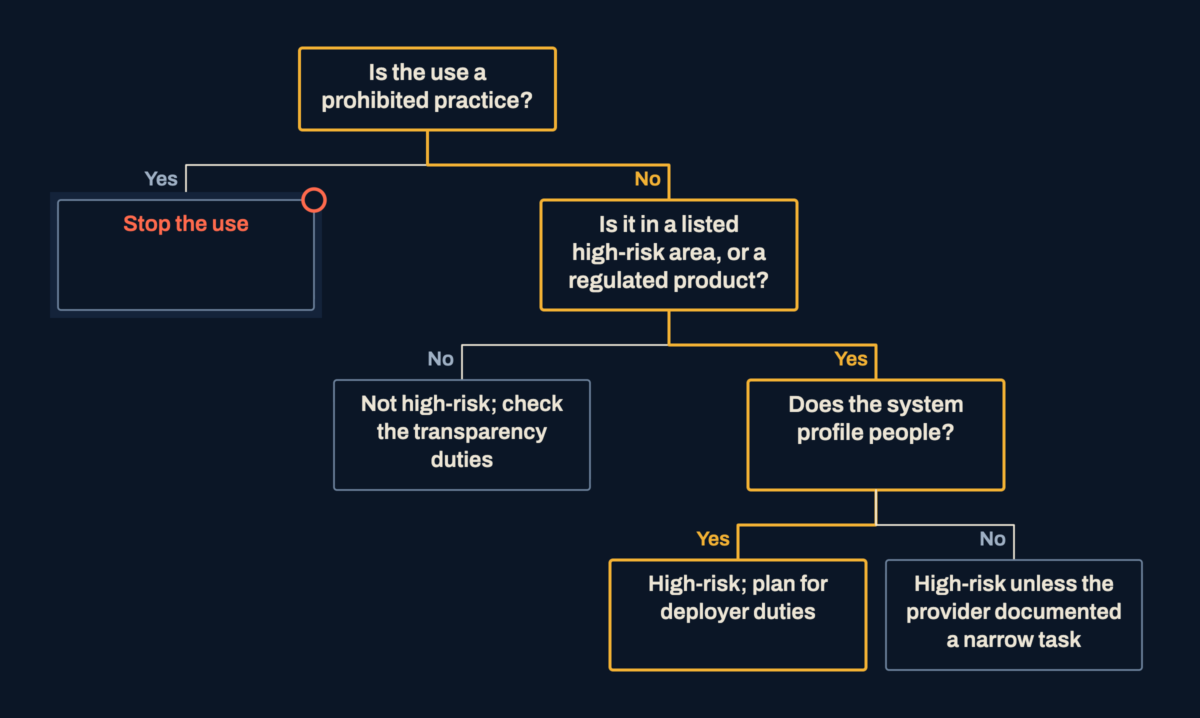
An Annex III system is not treated as high-risk when it poses no significant risk of harm, including by not materially influencing the outcome of decision-making, and meets one of the conditions listed in Article 6(3), such as performing a narrow procedural task. It is always high-risk when it profiles natural persons, and a provider that takes the exemption must document its assessment before placing the system on the market. Exhibit 2 puts these questions in order; it is our reading of the articles, not a legal test. (Source: Regulation (EU) 2024/1689, Article 6(3) and (4), as of 20 October 2026.)
Exhibit 2
Questions that place a system, in order
Text description of this exhibit
A tree of questions. First: is the use a prohibited practice? If yes, the outcome is to stop the use, marked in terracotta. If no, the second question: is it in a listed high-risk area, or a regulated product? If no, the outcome is not high-risk, check the transparency duties. If yes, the third question: does the system profile people? If yes, the outcome is high-risk, plan for deployer duties, drawn in blue. If no, the outcome is high-risk unless the provider documented a narrow task.
What will the high-risk rules ask of a deployer?
Article 26 expects a deployer to use a high-risk system according to its instructions for use; to assign human oversight to people with the necessary competence, training, authority and support; to monitor the system and, where it sees a risk, inform the provider and the authority and suspend use; to keep the logs it controls for at least the period the article sets, unless other law says otherwise; and, as an employer, to inform workers' representatives and affected workers before use at work. Regulation (EU) 2026/1744 does not amend Article 26: the list of articles amended in its Article 1 does not include it. (Sources: Regulation (EU) 2024/1689, Article 26(1), (2) and (5) to (7), as of 20 October 2026; Regulation (EU) 2026/1744, Article 1, as of 20 October 2026.)
Article 27 adds an assessment of the effect on fundamental rights before first use for deployers that are public-law bodies or private entities providing public services, and for deployers of systems that assess creditworthiness or the risk of life and health insurance customers, with the results notified to the market surveillance authority. The amendment replaced paragraphs 4 and 5: the assessment may cross-refer to a data protection impact assessment, and the AI Office is to develop a questionnaire template. (Sources: Regulation (EU) 2024/1689, Article 27(1) and (3), as of 20 October 2026; Regulation (EU) 2026/1744, Article 1(13), as of 20 October 2026.)
A system already in use is treated differently. As amended, Article 111(2) applies the high-risk rules to systems placed on the market or put into service before the date of application only if, from that date, their design is significantly changed. What counts as a significant change to a system a business built for itself is a question for counsel. (Source: Regulation (EU) 2026/1744, Article 1(39)(a), as of 20 October 2026.)
What has been published to help providers comply?
The amendment's second recital blames the delay on late standards and late national frameworks. The Commission has now published the reference to the first harmonized standard, EN 18286:2026, on quality management systems, which gives providers that apply it a presumption of conformity with the Article 17 requirements it covers. A deployer can ask its provider whether it does. (Sources: Regulation (EU) 2026/1744, recital 2, as of 20 October 2026; European Commission, First harmonised standard supporting the AI Act published in the Official Journal, last updated 19 October 2026, as of 20 October 2026.)
Article 26 puts oversight, monitoring, logs and worker information on the deployer.
(Sources: Regulation (EU) 2024/1689, Articles 4, 5, 6, 26, 27 and 50, as of 20 October 2026.)
What should a business do with the time?
The sequence follows from the texts, and it is our reading of them. Check the inventory of AI in use against Article 5, including the additions that apply in December 2026, and confirm what the business does under Articles 4 and 50. Classify each system against Annex III and Article 6(3), and name an owner for each that is or may be high-risk, because Article 26 puts oversight, monitoring, logs and worker information on the deployer. Ask each provider for the instructions for use, which Article 26(1) makes the standard of correct use, and check whether Article 27 applies. (Sources: Regulation (EU) 2024/1689, Articles 4, 5, 6, 26, 27 and 50, as of 20 October 2026.)
What is not in this briefing?
It does not cover regimes outside the European Union, the proposed changes to data protection rules that the Parliament's tracker shows in separate procedures, the rules for general-purpose AI models, or the penalties. It does not say whether any system you run is high-risk, which depends on facts about the system. Nothing in it is legal advice.
Method, as-of date and limits
The position described is that of 20 October 2026. Every source was read on that date, in a web browser, from the publisher's own page.
Regulation (EU) 2026/1744 was read in the Official Journal text on EUR-Lex: the title, recital 2, Article 1 points (5), (7), (13), (39) and (40), the list of articles it amends, Article 4 and footnote 4. Regulation (EU) 2024/1689 was read in its original Official Journal text: Articles 5(1), 6, 26, 27(1), 50 and 113 and Annex III. That text is not consolidated, so any passage the amendment replaced is taken from the amending text. The Parliament's tracker was read for the procedural dates, and the Commission's pages for the prohibitions, the transparency guidelines and the first standard. The briefing is reviewed every quarter and keeps this date until then.
- We read the provisions that the statements rely on, and not every provision of either regulation.
- We read the Commission pages that announce the transparency guidelines and the harmonized standard, not the documents themselves.
- We did not check whether the Commission has published the guidelines on classification that Article 6(5) calls for.
- The dates before signature come from the Parliament's tracker. The date of entry into force is our calculation from the rule in Article 4 and the date of publication.
- Further amendments are possible. Check the dates against the Official Journal before you rely on them.
- Interpretation of how Article 26 applies to a particular system is for your counsel.
Sources
All sources were read on 20 October 2026.
- Regulation (EU) 2026/1744 of the European Parliament and of the Council of 8 July 2026, amending Regulations (EU) 2024/1689, (EU) 2018/1139 and (EU) 2023/1230 (Official Journal, 24 July 2026)
- Regulation (EU) 2024/1689 (the Artificial Intelligence Act), Official Journal of 12 July 2024
- European Parliament Legislative Train: Digital Omnibus on AI (information updated 20 September 2026)
- European Commission: AI Act (regulatory framework page)
- European Commission: Guidelines on transparency obligations for providers and deployers of AI systems (updated 31 July 2026)
- European Commission: First harmonised standard supporting the AI Act published in the Official Journal (updated 19 October 2026)
Use this
List the AI systems in use, mark each against Annex III, and name an owner for every one before the end of the year.
Related
Does this describe a decision in front of you?
Tell us what is at stake and what has been tried. A senior practitioner replies with a suggested first conversation.