Market intelligence briefing
The white-label and outsourced delivery market
White-label delivery works when the buyer has no reason to ask who does the work. Three EU instruments now give some buyers a duty to ask. This briefing reads them, and the rule that implements one of them, with the source and date for every claim.
- Author
- Amit GovilFounder and CEO, XONIK
- Published
- October 22, 2026
- As of
- October 20, 2026
- Reading time
- 8 min read
In this briefing
Voice and options
Read aloud by the voice on your device. Nothing is sent to us.
In brief
Outsourced and white-label delivery now meets rules that make some buyers answerable for their suppliers' suppliers, as of 20 October 2026. GDPR Article 28 covers personal data, NIS2 Article 21 covers entities in listed sectors, and DORA Articles 28 and 30 cover financial entities. A hidden delivery chain does not fit these texts.
Key findings
The GDPR, DORA and NIS2 each make the buyer answerable for what its supplier does with the work.
The GDPR requires a controller to use only processors able to show they will meet its requirements, DORA keeps a financial entity fully responsible for its obligations when it uses ICT services, and NIS2 requires entities in scope to manage supply chain security with their direct suppliers. (Sources: Regulation (EU) 2016/679 (GDPR), Article 28(1), as of 20 October 2026; Regulation (EU) 2022/2554 (DORA), Article 28(1)(a), as of 20 October 2026; Directive (EU) 2022/2555 (NIS2), Article 21(1) and (2)(d), as of 20 October 2026.)
DORA goes furthest: a provider must be able to identify its subcontractors and give the financial entity what it needs to assess them.
The contract with each subcontractor must give the financial entity and its authorities the same rights of access and inspection as the provider's own contract. (Source: Commission Delegated Regulation (EU) 2025/532, Articles 3(1), 4(1) and 6, as of 20 October 2026.)
Relying on a provider's own assessment of its subcontractors does not reduce the financial entity's final responsibility.
The length and complexity of the chain, the location of subcontractors and concentration in one subcontractor are factors the financial entity must weigh. (Source: Commission Delegated Regulation (EU) 2025/532, Articles 1 and 3(3), as of 20 October 2026.)
An agency that sells ICT services to a financial entity is the supplier whose subcontracting that entity must assess.
Under DORA an undertaking providing ICT services is an ICT third-party service provider. (Source: Regulation (EU) 2022/2554 (DORA), Article 3(19), as of 20 October 2026.) Whether a particular agency falls within NIS2 depends on scope rules in the directive that we did not read, and on national law. (Sources: Directive (EU) 2022/2555 (NIS2), Article 6(39) and Annex I, as of 20 October 2026.)
An agency should be able to say who does the work, where and under what contract.
It can obtain the client's authorization before a partner touches personal data, and show that the duties that bind it are written into the agreement with the partner. (Sources: Regulation (EU) 2022/2554 (DORA), Article 30(2)(a) and (b), as of 20 October 2026; Regulation (EU) 2016/679 (GDPR), Article 28(2) and (4), as of 20 October 2026.)
What is changing in outsourced delivery?
White-label delivery depends on the buyer contracting with the agency and having no reason to ask who does the work. Three EU instruments give certain buyers a reason to ask, because each makes the buyer answerable for what its supplier does with the work. The GDPR requires a controller to use only processors able to show they will meet its requirements; DORA keeps a financial entity fully responsible for its obligations when it uses ICT services; and NIS2 requires entities in scope to manage supply chain security in their relationships with direct suppliers and service providers. (Sources: Regulation (EU) 2016/679 (GDPR), Article 28(1), as of 20 October 2026; Regulation (EU) 2022/2554 (DORA), Article 28(1)(a), as of 20 October 2026; Directive (EU) 2022/2555 (NIS2), Article 21(1) and (2)(d), as of 20 October 2026.)
Each applies within its own scope: the GDPR where an agency processes personal data on a client's behalf, NIS2 where the client is an essential or important entity in a sector it lists, and DORA where the client is a financial entity and the agency provides it with ICT services. NIS2 is a directive that Member States apply through national law, with national measures due to apply from 18 October 2024, and DORA has applied since 17 January 2025. Exhibit 1 sets the three beside each other. (Sources: Directive (EU) 2022/2555 (NIS2), Articles 21(1) and 41, as of 20 October 2026; Regulation (EU) 2022/2554 (DORA), Article 64, as of 20 October 2026.)
Exhibit 1
What each text says about the supplier's suppliers
| Instrument | What it says about suppliers' suppliers | Our reading for a subcontracted delivery | Source and date |
|---|---|---|---|
| GDPR, Article 28(2) and (4) | A processor does not engage another processor without the controller's prior specific or general written authorization. Under a general authorization it tells the controller of intended changes, which gives the controller the chance to object. The same data protection duties pass to the other processor by contract, and the first processor stays fully liable to the controller. | If a partner touches personal data, the client has authorized it, hears of changes, and holds the agency liable for the partner | Regulation (EU) 2016/679, Article 28; as of 20 October 2026 |
| NIS2, Article 21(2)(d) and (3) | Entities in scope take measures for supply chain security, including security-related aspects of relationships with direct suppliers and service providers, and take into account each direct supplier's specific vulnerabilities and the quality of its cybersecurity practices, including secure development procedures. | A client in scope has reason to ask its direct supplier how it handles its own suppliers; the text names direct suppliers only | Directive (EU) 2022/2555, Article 21; as of 20 October 2026 |
| DORA, Articles 28(3) and 30(2)(a) and (b) | A financial entity keeps a register of all contractual arrangements for ICT services. Each contract states whether subcontracting of a service supporting a critical or important function, or material parts of it, is permitted and on what conditions, and the locations where contracted or subcontracted services are provided and data is processed. | A financial client will list the agency and want the contract to say whether, where and under what conditions a partner may be used | Regulation (EU) 2022/2554, Articles 28 and 30; as of 20 October 2026 |
| Delegated Regulation (EU) 2025/532, Articles 3 to 6 | Before contracting, the financial entity decides whether a provider may subcontract a service supporting a critical or important function. The contract names which services may be subcontracted, makes the provider responsible for the subcontractors' services and requires notice of material changes, which the entity may approve or object to before they take effect. | Where the work supports a critical or important function, a partner is added or changed only after the client has had notice and a chance to object | Delegated Regulation (EU) 2025/532, Articles 3 to 6; as of 20 October 2026 |
How far does the financial rule go?
DORA goes furthest. The Commission's delegated regulation specifies what a financial entity must assess when a provider subcontracts a service supporting a critical or important function. The provider must be able to identify every such subcontractor, tell the financial entity who they are, and give it the information needed to assess them. The contract with each subcontractor must give the financial entity and its authorities the same rights of access and inspection as the provider's own contract, and the financial entity may provide for termination where a provider subcontracts a service the contract did not permit to be subcontracted. (Source: Commission Delegated Regulation (EU) 2025/532, Articles 3(1), 4(1) and 6, as of 20 October 2026.)
The regulation also treats the length and complexity of the chain, the location of subcontractors and whether the service is concentrated in one subcontractor as factors the financial entity must weigh. Its Article 3(3) says that relying on a provider's own assessment of its subcontractors does not reduce the financial entity's final responsibility. (Source: Commission Delegated Regulation (EU) 2025/532, Articles 1 and 3(3), as of 20 October 2026.)
Could the agency itself be in scope?
Possibly, and the question runs both ways. NIS2 defines a managed service provider as an entity providing services related to the installation, management, operation or maintenance of ICT products, networks, infrastructure or applications, whether on customers' premises or remotely, and its Annex I lists managed service providers as a sector under ICT service management between businesses. Whether a particular agency falls within NIS2 depends on scope rules in the directive that we did not read, and on national law. (Sources: Directive (EU) 2022/2555 (NIS2), Article 6(39) and Annex I, as of 20 October 2026.)
Under DORA an undertaking providing ICT services is an ICT third-party service provider, so an agency that sells such services to a financial entity is the supplier whose subcontracting the financial entity must assess. (Source: Regulation (EU) 2022/2554 (DORA), Article 3(19), as of 20 October 2026.)
What does this mean for an agency that uses partners?
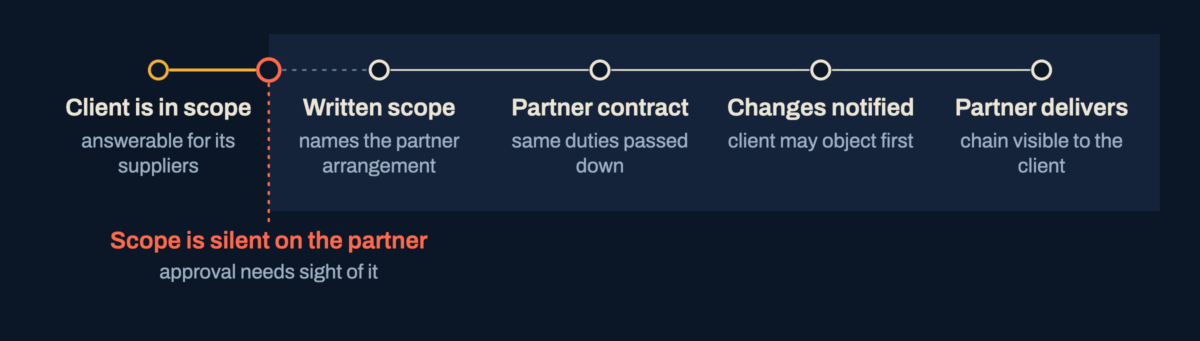
Our reading is that three things follow, each about being ready to answer a question. The agency can say, for any engagement, who does the work, where and under what contract, because DORA contracts must state locations and conditions of subcontracting. It can obtain the client's authorization before a partner touches personal data, and tell the client of changes, because that is what Article 28(2) of the GDPR sets up. And it can show that the duties that bind it are written into the agreement with the partner, because Article 28(4) of the GDPR requires the same data protection duties to pass down by contract. Exhibit 2 shows the chain. (Sources: Regulation (EU) 2022/2554 (DORA), Article 30(2)(a) and (b), as of 20 October 2026; Regulation (EU) 2016/679 (GDPR), Article 28(2) and (4), as of 20 October 2026.)
None of this forbids white-label delivery. It makes delivery that is hidden from a client who has a legal duty to see it hard to defend. The line, in the work, is the written scope: whether it names the arrangement, and whether the client has agreed to it. Under DORA that agreement, and notice of change, are built into the contract for services that support critical or important functions. (Sources: Commission Delegated Regulation (EU) 2025/532, Articles 4 and 5, as of 20 October 2026; Regulation (EU) 2016/679 (GDPR), Article 28(2), as of 20 October 2026.)
Exhibit 2
How the duty to see the chain reaches the partner
Text description of this exhibit
A line of five steps. First: client is in scope, answerable for its suppliers, drawn in blue. A terracotta mark follows it, labeled scope is silent on the partner, with the note that approval needs sight of it; the rest is shaded. Second: written scope, which names the partner arrangement. Third: partner contract, with the same duties passed down. Fourth: changes notified, so the client may object first. Fifth: partner delivers, with the chain visible to the client.
None of this forbids white-label delivery; it makes delivery that is hidden from a client who has a legal duty to see it hard to defend.
(Sources: Commission Delegated Regulation (EU) 2025/532, Articles 4 and 5, as of 20 October 2026; Regulation (EU) 2016/679 (GDPR), Article 28(2), as of 20 October 2026.)
What is not changing?
Work outside these scopes is untouched by these three texts. A client with no personal data in the work, not in a sector NIS2 lists and not a financial entity has no duty under them to ask about the agency's partners, and what the parties tell each other is a matter of their agreement. This briefing does not measure the size or shape of the outsourcing market, because no source read for it gives that, and it does not describe the rules of other countries. The Parliament's tracker shows proposals that would amend the GDPR and NIS2 as still pending in its information of 20 September 2026; the passages read here are not among the changes the tracker lists. (Sources: European Parliament Legislative Train, Digital Omnibus and Targeted amendments to the NIS2 Directive, updated 20 September 2026, as of 20 October 2026.)
Method, as-of date and limits
The position is that of 20 October 2026. EUR-Lex and the Parliament's own pages were each opened in a web browser that day.
The GDPR was read at Article 28 in the EUR-Lex text of 4 May 2016. NIS2 was read at Article 21, Article 41, the definition in Article 6(39) and Annex I. DORA was read at Articles 28 and 30, Article 64 and the definition of an ICT third-party service provider. Delegated Regulation (EU) 2025/532 was read in full. The Legislative Train pages for the two pending proposals were read for their summaries. The date moves at the next quarterly review. What a provision means for a subcontracted delivery is our reading, and the table marks it.
- Only the provisions named were read, not the whole of each instrument.
- We did not check for a consolidated GDPR text later than the version read, and we rely on the tracker for the pending proposals.
- Whether a rule applies to a particular client or agency depends on facts about it, which this briefing does not assess, including the scope rules of NIS2 and DORA.
- NIS2 is applied through national law, which we did not read for any Member State.
- The briefing says nothing about the size, growth or shape of the market. We have no source for that and state none.
- Take legal advice on how these provisions apply to a given arrangement.
Sources
The instruments and pages below were opened on 20 October 2026.
- Regulation (EU) 2016/679 (GDPR), Article 28
- Directive (EU) 2022/2555 (NIS2), Articles 6, 21 and 41 and Annex I
- Regulation (EU) 2022/2554 (DORA), Articles 3, 28, 30 and 64
- Commission Delegated Regulation (EU) 2025/532 of 24 March 2025 (Official Journal, 2 July 2025)
- European Parliament Legislative Train: Digital Omnibus Regulation proposal (information updated 20 September 2026)
- European Parliament Legislative Train: Targeted amendments to the NIS2 Directive (information updated 20 September 2026)
Use this
For your next engagement, write down who does each part of the work, in which country and under which contract, and see whether a client could be given that answer today.
Related
Does this describe a decision in front of you?
Tell us what is at stake and what has been tried. A senior practitioner replies with a suggested first conversation.