The Field Report
Agreed in the meeting, owned by no one
The room agreed and the minutes say so. Weeks later nothing has happened. Nobody refused, because nobody was asked.
- Author
- Amit GovilFounder and CEO, XONIK
- Published
- October 22, 2026
- Reading time
- 8 min read
In this piece
Voice and options
Read aloud by the voice on your device. Nothing is sent to us.
In brief
A decision made in a meeting stays unowned because each person leaves holding a different belief about who will act. Agreement costs nobody anything, while ownership costs the person who accepts it. A decision is owned only when one named person says so aloud, with the means to act, before the room breaks up.
Key findings
The avoidance in the room is courteous, which is why it goes unnoticed.
The chair does not name a peer, the peers do not volunteer and the person closest to the problem waits to be asked. The meeting ends in good order with a decision to which no cost is attached.
The wording of the minutes shows whether a decision has an owner.
Passive sentences, plural subjects, verbs such as explore and consider, and soft dates all signal that nobody has it. A decision with an owner begins with a name and a verb and ends with a date a stranger could check.
A function is not an owner, and neither is the person who raised the concern.
A department has a budget and a mandate but no mind to accept anything, and the sentence loses weight at each hand it passes through. Raising a concern is a contribution to the meeting, not an acceptance of the work.
Accepting a task without the means to do it is accepting the blame without the power.
Assignment is a social step and authority is a structural one, and the second catches the willing. A good owner declines in that case, which tells the group the decision needs a sponsor with authority before it needs a doer.
Assignment has to be a step of the meeting, taken before the item closes.
The chair, who should be the sponsor, asks the person who would carry the decision whether it is theirs. If nobody says yes, the group has learned something it could not see before: it has no decision.
Why does a decision everyone agreed to still have no owner?
Because agreement is free and ownership is not. A room can agree in a moment, and the agreement costs no one anything. An assignment costs the person who accepts it: their time, their exposure, and the risk of being the one who failed in public. A meeting that is not forced to take that step does not take it, and the avoidance is courteous, not hostile. The chair does not name anyone, because naming a peer in front of peers feels like an accusation. The peers do not volunteer, because the topic seems to sit in someone else's function. The person closest to the problem waits to be asked.
So the meeting ends in good order with a decision to which no cost is attached. Everyone has done their part, which was to agree.
Who leaves the room with what?
Take a leadership meeting in a retail business, held to decide whether an AI assistant that drafts refund decisions for customer-service staff should go live as planned. The discussion is good. The group concludes that larger refunds should not go out without a person checking them. Nobody disagrees. The minute reads: a review step will be introduced before refunds go live.
Follow each person out of the room. The executive sponsor leaves with a sense of progress and the belief that customer operations will do it, because refunds are an operations process. The head of customer operations leaves believing that the rules for the check are a risk matter, and that risk will send them. The head of risk leaves believing that an opinion was asked for and given. The technology lead leaves expecting a ticket to arrive if the work is wanted, and with no budget to begin without one. The vendor manager, who was present for the first part only, leaves with the original go-live date, which sits in a plan that was agreed in another meeting. The chief of staff writes the minute in the passive voice, because nobody gave an instruction to write it otherwise.
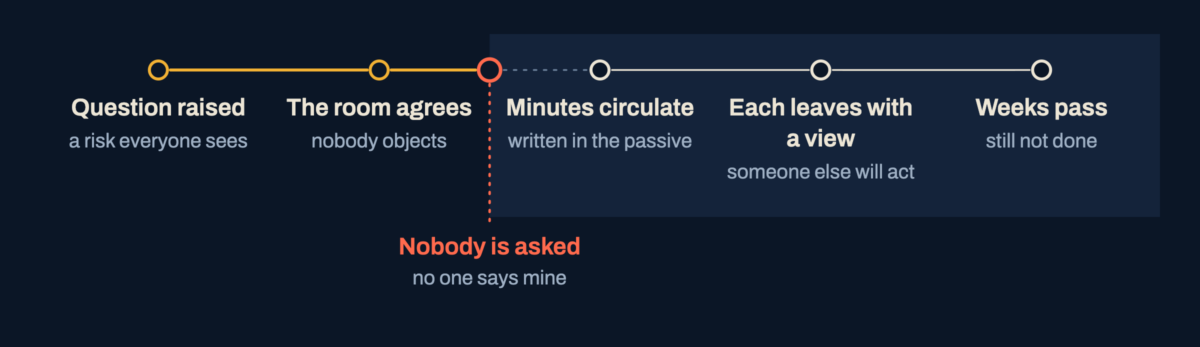
Everyone left with something true: a view of what ought to happen and a reasonable account of why it was someone else's to start. Exhibit 1 follows the decision from the question to the weeks after. The go-live date arrives. The review step does not exist. The meeting was clear, and the risk it named is now live.
Exhibit 1
Where a decision loses its owner
Text description of this exhibit
The steps run left to right. The question is raised, a risk everyone sees. The room agrees, and nobody objects. The minutes circulate, written in the passive voice. Each person leaves with a view that someone else will act. Weeks pass and the decision is still not done. The line is blue as far as the room agreeing. A terracotta mark right after it reads Nobody is asked, with the note that no one says mine. The shaded area begins at the mark.
What does the wording of the minutes give away?
The grammar of a decision shows whether it has an owner. Passive sentences have no actor: a review step will be introduced. Plural subjects have no single actor: we should, the team will, the business to confirm. Verbs of looking, such as to explore, to consider and to look at, describe a mood and not an act. Dates are soft: soon, next quarter, in due course. A decision with an owner reads differently. It begins with a name and goes on with a verb, and it ends with a date a stranger could check.
The minute-taker is not at fault. A secretary has no standing to assign work to senior people in front of their peers, so the passive voice is the form that offends nobody. The fault, if there is one, lies in a meeting that left no time for the assigning.
Is a function a valid owner?
A function cannot say yes. When the minute assigns the review step to customer operations, the head of that function hears a task for the department, passes it to a manager, who passes it to a team lead, and at each hand the sentence loses the weight it had in the room. A department has a budget and a mandate, and it has no mind to accept anything. Only a person can be asked whether the work is theirs.
The person who raised the issue is not an owner either, though the room often assumes it. Raising a concern is a contribution to the meeting. It becomes ownership only when that person is asked and accepts, and people who raise a concern would often refuse it, since they raised it precisely because the work was not theirs.
What lies between agreeing and owning?
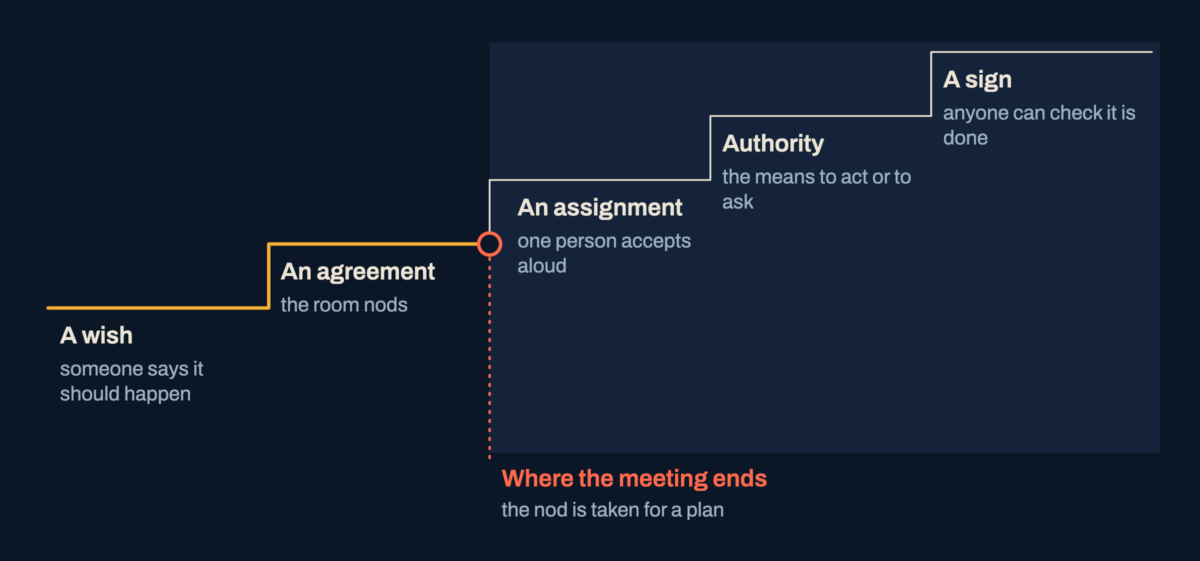
A decision climbs through steps, and a meeting reliably delivers only the second. Exhibit 2 shows them. A wish is a statement that something should happen. An agreement is the absence of objection. An assignment is one person, in the room, accepting the work. Authority is that person's means to carry it out: to spend, to direct other people's effort, or at least to know whom to ask and to be answered. The sign is the thing an outsider could look at and say it has been done.
Exhibit 2
The steps between a wish and a finished decision
Text description of this exhibit
A stair of levels, lowest first. A wish: someone says it should happen. An agreement: the room nods. An assignment: one person accepts aloud. Authority: the means to act or to ask. A sign: anyone can check it is done. The stair is blue up to the second level. A terracotta mark after it reads Where the meeting ends, with the note that the nod is taken for a plan. The levels above the mark are shaded.
Why is the move to authority harder than the move to agreement?
The move from agreement to assignment is social. It needs somebody to be asked and to say yes, and nothing in a normal agenda asks. The move to authority is structural, and it catches the willing. A person who accepts a task without the means to do it has accepted the blame without the power. A good owner declines in that case, and the refusal is information: the decision needs a sponsor with authority before it needs a doer.
A person who has not said yes, aloud and in the room, has not been assigned.
What changes it in the room?
Treat assignment as a step of the meeting, taken before the item closes. The person who chairs, who should be the sponsor or sit above the people being assigned, asks the one who would carry the decision: is this yours? The answer is spoken, in the room, and a person who has not said yes has not been assigned. A chair who is a peer of everyone present cannot do this, because assignment is an act of authority. The sponsor stays until the items are assigned.
Then ask what the owner needs, and from whom. If the answer is a budget, an access right or a decision from someone who is not present, that person's name goes on the item as a dependency, with the date on which the owner will ask them. The owner's first act is already specified, and the item is no longer waiting for a stranger.
Ask how the room will know the work is done. The answer should be something an outsider could check without asking the owner: the review step exists in the refund workflow, and a sample of refunds shows it being used. If the answer is that the owner will say so, the sign is missing, and the decision will finish when the owner stops thinking about it and not when the work is complete.
If nobody says yes, write that down. An item with no owner is an unfunded wish, and the group has learned something it could not see before: it has no decision. Give the item back to the sponsor, whose business it now is to supply a person or to withdraw it. Open the following meeting with the list, owners speaking first, starting with the items past their dates. A list read at the start of each meeting becomes a habit, and one that is not read becomes a record of intentions.
The NIST AI Risk Management Framework 1.0 asks for the same thing at the scale of an organization: roles and responsibilities documented and clear to individuals and teams (GOVERN 2.1), and executive leadership taking responsibility for decisions about the risks of AI development and deployment (GOVERN 2.3). A meeting is where those sentences either become true or do not. The method here comes from delivery work and not from measurement; it is offered as something to try at your next meeting.
Sources
The first release of the framework was opened on 20 October 2026. The meeting described is a composite of patterns from delivery work and not an account of any one company.
Use this
At your next meeting, read back every decision with a name, a date, the authority and the sign before anyone leaves the room.
Related
Does this describe a decision in front of you?
Tell us what is at stake and what has been tried. A senior practitioner replies with a suggested first conversation.