White paper
Answer engines and enterprise buyers: how supplier shortlists change
By the time a supplier hears about a deal, the buyer has usually built a shortlist. This paper asks how answer engines change that for enterprise buyers: what changes when part of that work happens inside an answer from an AI assistant, and what stays exactly as it was.
- Author
- Amit GovilFounder and CEO, XONIK
- Published
- October 22, 2026
- Reading time
- 20 min read
In this paper
Voice and options
Read aloud by the voice on your device. Nothing is sent to us.
In brief
Answer engines can build part of an enterprise buyer's shortlist inside a written answer that names suppliers and cites sources, in a conversation the supplier never sees. They weigh a supplier's claims against what other sources say, and they reward a consistent account of the firm. Procurement, people and evidence still decide who wins the work.
Key findings
The shortlist can form inside an answer, and the supplier sees neither the question nor the reading
These products interpret the question, retrieve pages, compose an answer and show the sources they used. A buyer who's satisfied by the answer has no reason to open a supplier's site, and the answer may frame the need before it names anyone. That second part is our inference.
A supplier's claims are weighed against what independent sources say
What a supplier says about itself is evidence of what the supplier says. That a composed answer leans on other people's pages is our inference from the mechanism, and no provider documents a rule that favors third-party sources.
Consistency across sources matters more than any one page
An answer is assembled from pages written for other purposes, at other times, by other people. If they disagree about what the firm does, the answer has to pick one account or blur them. Adding markup doesn't fix that; the visible facts have to agree wherever they're stated.
The answer, not the ranking, becomes the unit of competition
An answer is composed anew for each question, engine and day, and each member of a buying group asks different questions. The only measure is a dated record of named questions put to more than one product.
Being named isn't being chosen, and being named for work the supplier can't show costs more than not being named
A contract still passes through written criteria, references, terms and sign-off. At evaluation the buyer checks what was claimed, and people still form their views through conversations and references that no summary replaces.
The first decisions belong to leadership: access, one account of the firm, and a routine of testing
We can't say how often buyers rely on an answer at this stage. The cost of being wrong is lopsided, which argues for a decision from leadership and a small, dated test.
Why should a leader care now how enterprise buyers use answer engines?
By the time an enterprise buyer calls a supplier, a stage of the purchase has already run its course. Someone named a problem, a group formed around it, and that group built a list of suppliers and decided what it believes about each. The supplier is missing from that stage because nothing in it needs the supplier to be there.
Public procurement rules show how old and formal the stage is. The US Federal Acquisition Regulation, at 10.001, requires agencies to do market research before they develop a new requirements document and before they solicit offers above the simplified acquisition threshold, and it lists what the research is for, including to determine whether sources capable of satisfying the requirement exist. Section 10.002 lists techniques: contacting knowledgeable people in government and industry, reviewing the results of recent market research, reading the catalogs and product literature that manufacturers, distributors and dealers publish, and obtaining source lists. The UK Cabinet Office's Sourcing Playbook of June 2023 describes early engagement with the market in its own terms, and adds a constraint that matters later in this paper: preliminary consultation must be handled so that no supplier gains a preferential advantage.
A private company has no such rule, and we aren't claiming these documents describe private buying. We use them for one narrow point. The stage before contact is a recognized part of buying, it runs on what the buyer can read, and the buyer forms a view before any supplier speaks. Our own delivery experience points the same way: the buyers and leaders we talk to tend to arrive with a list already in mind.
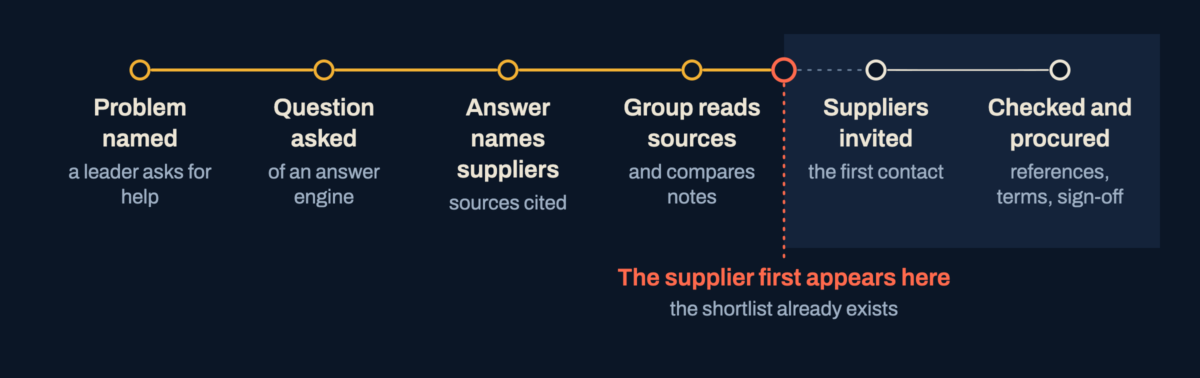
An answer engine, in this paper, is an assistant or search feature that composes a written answer from retrieved pages and shows the sources it used. It changes where part of that stage happens. A summary names some suppliers, cites some pages and gets read in a conversation the supplier never sees. The diagram below shows the route, and the supplier first appears in its own right only after the shortlist exists.
The route of an enterprise purchase, and where the supplier first appears
Read this as text
The flow runs from left to right. First, a problem is named: a leader asks for help. Then a question is asked of an answer engine. Then the answer names suppliers and cites sources. Then the buying group reads the sources and compares notes. Then suppliers are invited, which is the first contact. Last, the purchase is checked and procured through references, terms and sign-off. A break is marked between the group's reading and the invitation, labeled that the supplier first appears here because the shortlist already exists. The steps after the break are shaded.
So what does this change for a supplier, and what doesn't it? We wrote this for a chief executive or a head of marketing who has to decide whether the matter deserves leadership attention, not for the person who would do the technical work. Our report on being found by buyers who use AI assistants covers how a firm becomes findable and how to fix access. This paper looks at the buyer's route and the supplier's position.
We argue that the shortlist can form without a visit, that claims are weighed against what independent sources say, that consistency across sources matters more than any single page, and that the unit of competition becomes the answer instead of the ranking. Then we say what stays as it was, because an argument about change fails if it overstates the change.
Method and limits
This paper is an argument built on material of different kinds, and we label each kind where we use it. The first is the public documents of a US and a UK procurement rule-maker, read for the passages cited; they show that the stage before supplier contact is recognized and governed. The second is the providers' own documentation of how their products retrieve and cite pages: Google Search Central, OpenAI, Anthropic and Perplexity, read on 23 October 2026. The third is one study by the Pew Research Center, charted from a stored copy of its published figures; the prose says what the study measured and doesn't repeat its figures. The fourth is the firm's delivery experience, described as pattern and mechanism and marked as such.
Where a statement is an inference, the sentence says so. We make no claim about how widely enterprise buyers use answer engines, because we found no primary source we could read that measures it. Analyst surveys of business buyers exist, but the releases we tried were behind a paywall or wouldn't open, so we cite none.
- We didn't test any assistant for this paper, and we measured no rate of appearance.
- The Pew study followed Google searches by adults in the United States in March 2025. It didn't study enterprise buyers, other engines or the buying of services, and the way a feature appears can change over time.
- The procurement documents describe public buyers. Private buying has no equivalent rule, and our account of it rests on delivery experience.
- The providers document access and citation. They don't document how one source is chosen over another, so what we say about that is inference.
- The documents change without notice, and we read each on one date.
- Engagements are under NDA, so no client material appears.
Can an enterprise shortlist form without a visit to any supplier's website?
It can, because of how the products are built. The providers describe a common sequence: the product interprets the question, searches or retrieves pages, composes an answer, and shows its sources. Perplexity's help center describes it as understanding the question, searching the web and summarizing, with numbered citations. Anthropic's documentation says Claude determines when to search from the prompt, the API runs the searches, and Claude ends its turn with a response that cites its sources; citations are always enabled for its web search tool. Google says both of its AI features can run a technique it calls query fan-out, issuing related searches across subtopics and data sources, and so can display a wider and more diverse set of links than classic search. OpenAI's documentation for its API search tool, which is a developer product and not the ChatGPT application, says inline citations are included by default and that its sources field lists every URL the model consulted, not only those it cited.
In every case the reader meets the answer before any source. A buyer who's satisfied by the answer has no reason to open a supplier's site, and a buyer who does open a source opens one the answer chose. That's the first change: the shortlist, and the first description of each name on it, can form inside the answer. The supplier sees neither the question nor the reading.
The answer may also frame the need before it names anyone. A buyer who asks about a problem can get a description of the kind of supplier that solves it, and the shortlist then forms inside that category. A supplier whose offer doesn't match the category as the answer defines it can be capable and still go unnamed. That's our inference from how answers are composed, not a documented behavior, and it's why the framing row of the table below isn't empty.
Not every stage of a purchase changes. The table below goes through them and sets out where a supplier could act before and where it can act now.
The stages of a purchase, before and with an answer engine
| Stage | Where the supplier could act before | Where the supplier can act with an engine in the route | What does not change |
|---|---|---|---|
| Problem named | Nowhere. The problem is internal to the buyer. | Nowhere. The problem is still internal. | A leader owns the problem and the budget. |
| Need framed | Through published research and talks that colleagues, peers and analysts read. | The same, and an answer may now repeat the framing back, describing the problem and the kinds of supplier that address it. | The group decides what it is buying. |
| Shortlist built | Through search presence, referrals and lists, where the buyer chooses what to open. | Through whether an answer names the supplier, and in whose words, as well as the routes before. | Referrals and past dealings still add names. |
| Claims weighed | Through its own pages, which the buyer sets against other pages by opening several. | Through what the answer sets beside the supplier's claim, in one view, before the buyer opens anything. | Independent evidence outweighs self-description. |
| Suppliers contacted | Through the first meeting, where the buyer's view is still forming. | Through the first meeting, where the buyer may arrive with a summary the supplier didn't write. | Meetings, demonstrations and references. |
| Procured | Through the written response to written criteria. | The same. | Procurement rules, contracts and sign-off still apply. |
The shortlist row and the claims row carry the argument. Before, a supplier acted through its search presence and its referrals. Now it can also act on whether an answer names it. In the claims row, the buyer used to weigh a supplier's page against others by opening several, and an answer now does a first pass of that weighing in one view.
We don't know how often buyers rely on an answer at this stage, and the argument doesn't need us to. The cost of being wrong is lopsided. A supplier that prepares for a habit that never spreads has written clearer pages and aligned its facts, which human readers value anyway. A supplier that ignores a habit that does spread learns of its absence from a pipeline it can't see. That's a reason for a decision from leadership and a small, dated test, not a large initiative.
Why are a supplier's claims weighed by what independent sources say?
An engine that answers a question about suppliers composes from the pages it retrieves, and the supplier's own page is just one of them. What a supplier says about itself is evidence of what the supplier says. A system that has to write a sentence about what a firm is known for has little else to set against it than other pages.
The documents give a hint of this. Anthropic lists, among the cases in which Claude searches, information about specific organizations, people or products that might have changed. A buyer who asks Claude about a named supplier therefore sets off a search of the web at large, not only of that supplier's site. Google's guidance on people-first content says trust is the most important of the aspects it lists, and asks who made a piece of content, how, and why. It also says the framework behind that list isn't itself a specific ranking factor, and none of the provider pages we read documents a rule that favors third-party sources. That a composed answer leans on other people's pages is our inference from the mechanism, and you should test it.
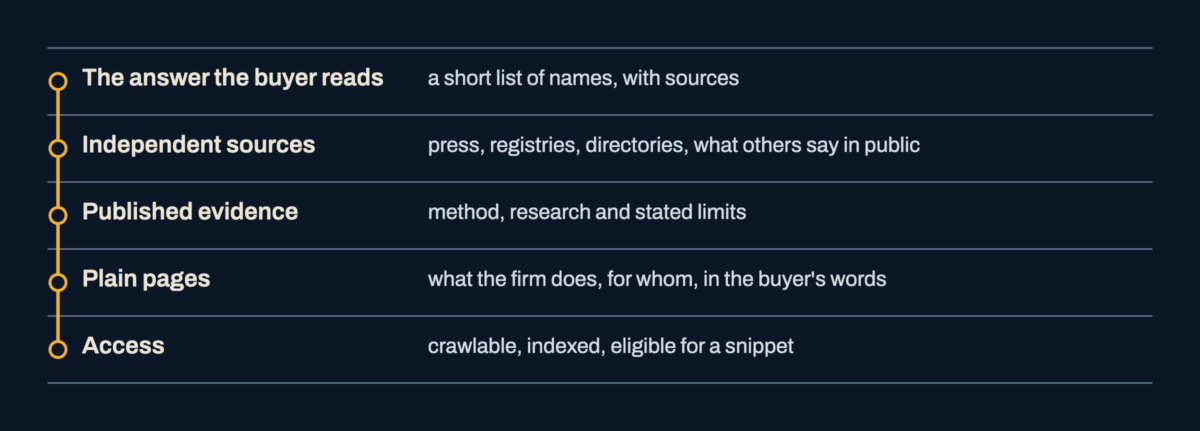
The diagram below sets out the layers of evidence an engine can weigh. The lowest layers are the supplier's to write: access, which the providers document, and plain pages that say what the firm does and for whom. The next is the supplier's to publish: method, research and stated limits, which give a reader, human or machine, something to check. The layer above isn't the supplier's to write at all. It's what others say in public: press, registries, directories, standards bodies, and statements by customers who choose to make them.
Buyers already work this way in the public rules. Section 10.002 of the Federal Acquisition Regulation lists, among its techniques, reviewing the results of recent market research and obtaining source lists from other contracting activities, trade associations and other sources. A buyer who starts from other people's compilations has always treated them as a check on what suppliers say about themselves. An answer engine automates part of that habit and puts it where a busy buying group will meet it first.
The practical consequence is a change of target. A supplier can't write the independent layer, but it can publish evidence that others find worth citing, and it can keep the facts in that layer correct where it has a hand in them, such as a directory entry or a registry record. We'd expect a claim that rests only on the supplier's own pages to be repeated with caution or left out, and a claim that other sources repeat to be stated plainly.
Layers of evidence an answer engine can weigh
Read this as text
The layers are stacked, top to bottom. At the top is the answer the buyer reads: a short list of names, with sources. Below it are independent sources: press, registries, directories and what others say in public. Below that is published evidence: method, research and stated limits. Below that are plain pages that say what the firm does and for whom, in the buyer's words. At the bottom is access: pages that are crawlable, indexed and eligible for a snippet. Each layer rests on the ones below it.
Why does consistency across sources matter more than any one page?
One question becomes a set of searches. Google says its AI features may issue related searches across subtopics, and each may return a different page. The answer is then assembled from pages written for other purposes, at other times, by other people: a service page, an about page, a sector page, a job advertisement, a directory profile. If they disagree about what the firm does, the answer must choose one account or blur them, and the buyer reads whichever it produced.
The providers treat identity as a real problem. Google's guidance on Organization structured data says the markup helps it understand an organization's administrative details and disambiguate the organization in search results. It names the properties: the name, which should match the site name, an alternate name, the legal name, the home page address, a logo, and links to the organization's pages elsewhere. Google adds that it can't promise features that use structured data will show up. Its general guidance says not to mark up information that isn't visible to the user, and its guidance on AI features asks that structured data match the visible text of the page and says no special markup is needed to appear. Whatever markup you add, the visible facts have to agree wherever they're stated.
In our delivery work on how firms describe themselves, the pattern is drift. The services page gets rewritten and the directory entry doesn't. A name changes after a reorganization and the old one lingers in filings and press. A sector page uses vocabulary the rest of the site doesn't. None of it matters to a human who lands on the home page and reads in order. It matters to a system that reads them all at once and has no reason to prefer the newest.
That's why consistency outweighs the quality of any one page. A very good page can't outweigh the pages that contradict it, and a buyer who asks more than one product may read different accounts of the same firm. Google also notes that different models and techniques can sit behind AI Overviews and AI Mode, so their responses and links can differ. The cost is a firm described by its oldest or loosest account, or confused with a similarly named one, in the first conversation a buyer has about it.
A position belongs to a page; an answer belongs to a question, an engine and a day.
Why does the answer, and not the ranking, become the unit of competition?
In a ranked list, a supplier competes for a position on a page the buyer scans, and a lower position still earns some attention because the buyer chooses what to open. In an answer, the competition is for inclusion in a composed text, decided afresh for each question because the text is composed anew each time. Think of a position as something a page holds, and of an answer as something that exists for one question put to one engine on one day.
The Pew Research Center's short read of 22 July 2025 gives a measured view of how often an answer appears. It followed the Google searches of a panel of adults in the United States in March 2025, had each search run again in April 2025, and recorded whether Google showed an AI summary at the top of the results. It then compared what people did next on pages with and without a summary. The diagram below shows the share of searches that produced a summary, by kind of search: short searches rarely did, and longer searches, searches written as full sentences and searches that begin with a question word did far more often.
The study concerns everyday Google searches by adults in one country, not enterprise buyers, and it can't say how a buying group searches. It supports a narrower point. The searches that produced a summary more often are the ones phrased as a situation and a need, and a buying group's research question is usually of that kind. That second step is our inference. It means the questions that matter to a supplier are the long ones, which a keyword list doesn't capture.
Members of a buying group ask different questions. The sponsor asks who can do the work. The security lead asks how a supplier handles data. Finance asks about terms. Each question gets its own answer and may name different suppliers, so a supplier can be present for one and absent for another. Google says AI Overviews are shown only when its systems judge them additive to classic search, and describes AI Mode as particularly helpful for queries that need further exploration, reasoning or complex comparison. Pew notes that the summary for a given search may change over time.
That changes how you find out where you stand. A rank is a number the supplier can read from a report. An answer has to be asked for. The only measure available is a dated record of named questions put to more than one product, with what each answer said about the firm and which sources it cited. Google reports traffic from its AI features inside the Web search type in Search Console. The pages we read for the other providers don't describe a comparable report.
How often Google produced an AI summary, by kind of search
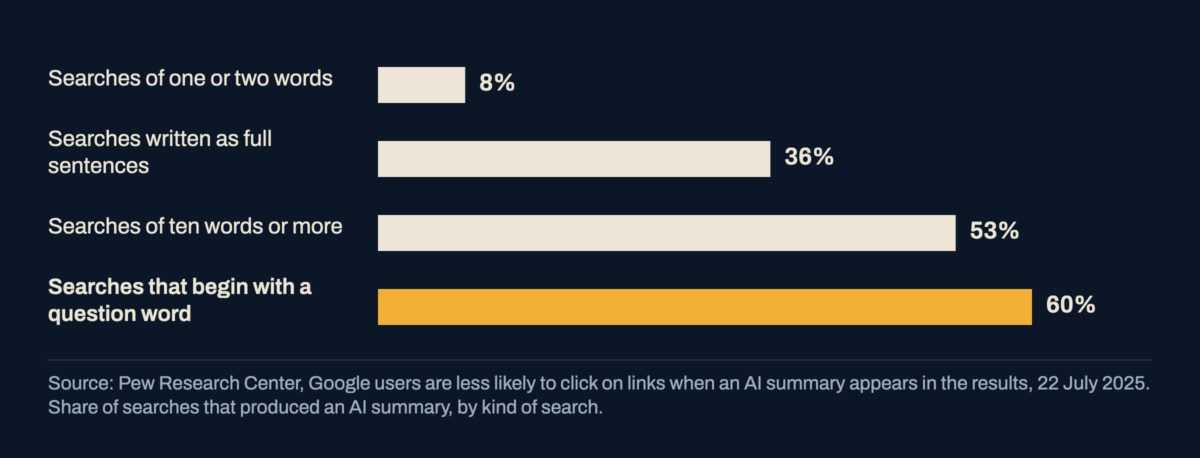
Source: Pew Research Center, Google users are less likely to click on links when an AI summary appears in the results. As of 22 July 2025 (study of searches in March 2025).
Read this as text
The bars show the share of searches that produced an AI summary in the study. The shortest searches, of one word or a pair, produced one least often. Searches written as full sentences produced one more often than that, the longest searches more often still, and searches that begin with a question word more often than any of the others. The values are printed on the chart and are read from the Pew Research Center's page. The study followed the Google searches of a panel of adults in the United States in March 2025.
What changes for suppliers when answer engines shape shortlists, and what stays?
These things change a supplier's position, and none is a trick. Google states that there are no additional requirements to appear in AI Overviews or AI Mode and no other special optimizations, and no provider documents a method of being chosen. The work is the same work, done to a higher standard and measured differently. The supplier writes pages that state plainly what it does and for whom, in the words a buyer uses. It publishes the reasoning and the limits behind its claims. It keeps one account of itself wherever it controls the text, and corrects the rest where it can. And it measures by question, on more than one product, on a schedule.
Some things don't change. Procurement still happens. The documents we read describe public buyers: the regulation treats market research as a step before soliciting offers, and the Playbook says preliminary consultation must leave no supplier with a preferential advantage. A private buyer's rules differ, but a contract still passes through written criteria, references, terms and sign-off, and an answer can put a name on a list without winning the work. People still decide. A buying group has a sponsor, a skeptic and a signatory, and each forms a view through conversations and references that no summary replaces. And evidence still wins. At evaluation the buyer checks what was claimed, so a supplier named for something it can't show loses more than one that was never named.
Some of the decisions belong to leadership, not to a technician. The first is whether retrieval crawlers may reach the firm's pages or are kept out; the providers document that as a separate setting from training. The second is what the firm will say about itself in one account, because that's a statement of position that others will repeat. Both are made once, in writing, and reviewed.
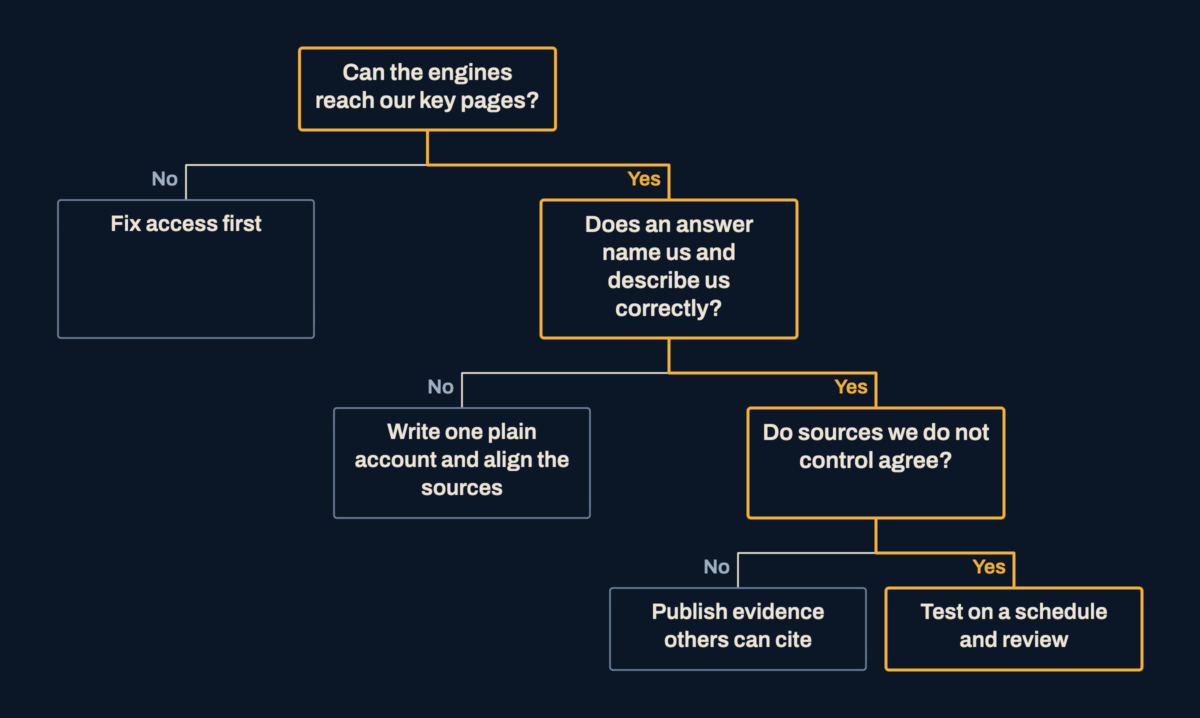
The diagram below puts the first decisions in order. It starts with access, because access is documented, cheap and certain. It moves to the description, then to the evidence, and ends in a routine of testing, because the products and their documents change.
What a leadership team should decide first
Read this as text
The tree starts with the question whether the engines can reach the firm's key pages. If not, the action is to fix access first. If so, the next question is whether an answer names the firm and describes it correctly. If not, the action is to write one plain account and align the sources. If so, the last question is whether sources the firm does not control agree. If not, the action is to publish evidence that others can cite. If so, the action is to test on a schedule and review. The route to the last action is drawn in blue.
What should a leadership team do, step by step?
- 01
Name an owner and a date for a decision
The chief executive asks the head of marketing, with a named sponsor on the leadership team, to own how the firm appears in answers. The owner reports on a set date. At the end you have a named owner, a sponsor and a date.
- 02
Write down the buyers' questions
The owner works with sales and with recent buyers to list the questions each member of a buying group asks before first contact, in their own words and at the length they would type. At the end there's a list grouped by role: sponsor, technical lead, security and legal, finance.
- 03
Ask the products and keep the answers
The owner puts each question to more than one answer engine and records, with the date, which suppliers were named, how the firm was described and which sources were cited. At the end there's a dated record that can be compared with the next one.
- 04
Fix access and the account
A technical owner reads robots.txt as each crawler would, confirms that key pages are indexed and can show a snippet, and decides on training crawlers separately. The owner and the leadership team agree one plain account of the firm: name, legal name, what it does, for whom. At the end access is confirmed and the account is written down.
- 05
Publish evidence that others can cite
The firm publishes the method and limits behind its main claims, and corrects the directory entries, registry records and profiles it can edit so that they match the account. At the end there are pages a third party could cite and sources that agree.
- 06
Review the record each quarter
The leadership team reads the record, compares it with the last, and decides whether to continue, change or stop. At the end there's a short decision log, with a reason for each decision.
How can you check your own position?
- I can name the person who owns how our firm appears in answers.
- We've written down the questions each member of a buying group asks before they contact us, in their words.
- We've put those questions to more than one answer engine in the last quarter and kept the answers with their dates.
- Our firm is named in the answers to the questions where it should be.
- Where we're named, the description matches what we would say ourselves.
- Our robots.txt file allows the retrieval crawlers we intend to allow, and we decided about training crawlers separately.
- Our key pages are indexed and can show a snippet.
- Each service page opens with what the service is, for whom, and what problem it answers.
- Our name, legal name and one-line description are the same on our site and on every directory and profile we control.
- Our main claims link to the reasoning or evidence behind them, with the limits stated.
- Sources we don't control describe what we do, and agree with us.
- Our leadership team has read the record of answers and made a decision on it in the last quarter.
What do leaders ask about answer engines and shortlists?
Do enterprise buyers really build their shortlist from AI answers?
We can't say how often. We found no primary source we could read that measures it, and we cite none. The argument is narrower: the stage before supplier contact already exists, and part of it can now happen inside an answer the supplier never sees.
Does an answer engine believe what we say about ourselves?
Probably not on your word alone, though no provider documents such a rule. We infer that an answer weighs a supplier's claims against other pages. The response is to publish method and limits that others can cite, and to keep directory and registry entries correct.
What should our leadership team decide first?
Start with access, because it's documented and certain: whether retrieval crawlers may reach your pages, decided apart from training crawlers. Then agree a plain account of the firm, publish evidence others can cite, and set a routine of dated testing, since the products and their documents change.
If an answer names us, have we won the work?
No. Being named isn't being chosen. A contract still passes through written criteria, references, terms and sign-off, and at evaluation the buyer checks what was claimed. A supplier named for work it can't show loses more than one that was never named.
Sources and notes
We read every document below on 23 October 2026. Where a document shows a date we give it, and where it shows none the entry says so. The Federal Acquisition Regulation pages were read as published at acquisition.gov on that date.
- Pew Research Center, short read of 22 July 2025 on clicks when Google shows an AI summary
- Federal Acquisition Regulation, 10.001 Policy (market research), FAC 2026-01, effective 13 March 2026
- Federal Acquisition Regulation, 10.002 Procedures (market research techniques), FAC 2026-01, effective 13 March 2026
- Cabinet Office (UK), The Sourcing Playbook, early engagement, pages 16 and 17 (June 2023, still the current version on GOV.UK)
- Google Search Central page on AI features, updated 10 December 2025
- Google Search Central guidance on people-first content, updated 5 October 2026
- Google Search Central page introducing structured data, updated 10 December 2025
- Google Search Central guidance on Organization structured data, updated 8 September 2026
- OpenAI overview of its crawlers (no date shown)
- OpenAI, Web search guide for the API (no date shown)
- Anthropic help center article on web crawling and how site owners can block the crawler (updated 7 April 2026)
- Anthropic, Web search tool, Claude API documentation (no date shown)
- Perplexity, How does Perplexity work? (no date shown)
- Perplexity page on its crawlers (no date shown)
Use this
Write down the questions your best buyers ask before they call you, and put them to more than one assistant this week.
Related
Do you know what an assistant says about your firm today?
Tell us which buyers matter to you and what you've seen an assistant say about you. A senior person reads it and replies with a way to test the answers that matter.