The Field Report
AI assistant recommendations: why it names your competitor and not you
It stings to see an AI assistant recommend your competitor with confidence. Before you decide anything, separate what the vendors document from what people are guessing.
- Author
- Amit GovilFounder and CEO, XONIK
- Published
- October 22, 2026
- Reading time
- 9 min read
In this piece
Voice and options
Read aloud by the voice on your device. Nothing is sent to us.
In brief
AI assistant recommendations tend to name the firm the assistant can check from the pages it reads. Where both firms are eligible, the differences we look for are a page that answers the buyer's question in its opening lines, one name and description used everywhere, and independent sources that agree. The vendors document eligibility, not selection.
Key findings
You and your competitor usually clear the same documented conditions, and clearing them doesn't oblige Google to crawl, index or serve the page.
No vendor explains how one eligible page is preferred to another, so this piece asks only what an assistant could check, by reading, about each firm.
An assistant works with passages, so a page helps only if it holds text that answers the question as asked.
Google builds snippets from the part of a page that best relates to a specific search, and OpenAI lists opening a page and finding text inside it as separate actions.
A firm with one name and one description everywhere is easier to identify than a firm with variants.
A system reading across the web has to decide that the name on one page is the firm on another. Google raises the problem on its Organization structured data page, and says its AI features need no special markup.
Agreement from outside the firm is the kind of evidence Google itself treats as relevant to a source.
Google's content guidance asks whether someone researching a site would find it well trusted. That concerns its ranking systems, not the names in an answer, and these checks are our reading, not a documented formula.
The passage can change this quarter, identity takes longer, and corroboration can't be done alone.
Look first at access, then at the opening of the page, then at how consistently the firm is described. A firm that tries to manufacture mentions is working on the wrong problem.
What can an assistant check about a firm by reading?
As we read the documents, an assistant can check the passage, the firm's identity, and whether anyone else agrees. Start with the passage. Google's guide to snippets says they are created from page content and chosen to preview the part that best relates to a user's specific search, so different searches produce different snippets. OpenAI's search tool lists opening a page and finding text inside it as separate actions. Both describe a pipeline that works at the level of passages. A page helps if it holds a stretch of text that answers the question as asked, and being about the right subject isn't enough.
Identity comes next. Google says adding Organization structured data to your home page can help it disambiguate your organization from others, and that a sameAs property can point to your profile pages on other sites. Its AI features page says no special markup is needed, so read this as the vendor describing a problem, not prescribing a fix. A system that reads pages from across the web must decide that the name on one is the firm on another. One name and one sentence of description everywhere makes that easy. Variants make it uncertain.
Corroboration comes last. Google's page on helpful, reliable, people-first content asks whether a page shows clear sourcing and background about its author or site, and whether someone researching the site would come away thinking it well trusted or widely recognized as an authority on its topic. It describes Google's ranking systems, not the choice of names in an answer. It does show that agreement from outside the firm is the kind of evidence the vendor treats as relevant to a source.
These checks are our reading, not a documented formula. No vendor says they decide the outcome, or how they would be weighed.
Where eligible firms part company
The table below sets the checks side by side for a pair of firms. We built them for illustration; they aren't records of any real business. Both pass the documented conditions, and every difference between them is something a system could establish by reading. Read down the rows, mark where the firms part, and then hold each row up against what your own pages publish today.
What an assistant can check about equally eligible firms
| Check | Firm A | Firm B |
|---|---|---|
| Reachable and eligible to be shown | Yes | Yes |
| Opening of the service page | Says what the firm does, for whom and in what order, in the buyer's words | Opens with an outlook and an invitation to get in touch |
| A passage an assistant could lift whole | A paragraph that answers the question and stands alone | The answer is spread across pages or held back for a call |
| The firm's name and description | One name and one sentence of description everywhere | Variant names, and a description that changes from page to page |
| Other sources about the firm | A trade body, publications and clients describe it in the same terms | Only the firm describes itself |
How can one equally able firm win the recommendation?
Take a retail business asking which firms can connect its store stock system to its online shop. The first firm has a long record of this work. Its page is titled with a service category, opens on a view of where commerce is heading, and describes its method in the vocabulary of its brand. It uses a short name on its site and its full legal name elsewhere. The only outside descriptions of it are directory entries, each written once and never revisited.
The second firm is no better at the work. Its page is titled with the problem, opens with a paragraph saying what it connects to what and for whom, and lays out the order the work is done in. A trade body's member page and a published talk describe it in the same terms. An assistant composing an answer has a sentence to lift from the second firm and can check that other sources agree. For the first it has nothing to lift and nothing to confirm.
Both firms are composites. This is how we'd expect it to go, an inference from how firms describe themselves and not an observation of any assistant. It suggests the firm that gets named is often the one that was easier to describe, and that isn't always the one that's better at the work.
The firm that gets named is often the one that was easier to describe, not the one that's better at the work.
An inference from how firms describe themselves, not an observation of any assistant.
Which of these can you change this quarter?
They move at different speeds. The passage is the quickest because it's your own text: you can rewrite a page in a day and test it the next. Identity takes longer, because it lives in every place the firm describes itself: the site, social profiles, speaker biographies, directory entries, press boilerplate, and the legal name on documents that end up online. One person should hold the approved name and a single approved description, the way a style guide holds a brand, and every outside party that asks for a description should get that text.
Corroboration is the slowest, and the only one you can't do alone. A trade body, a publication or a client describes a firm when it has a reason to, and the reason is usually work it can point to. The straightforward route is to do work worth describing and make it easy to describe correctly. A firm that tries to manufacture the mentions is working on the wrong problem, and nothing we read gives a basis for thinking it would help.
In what order do you look for the gap?
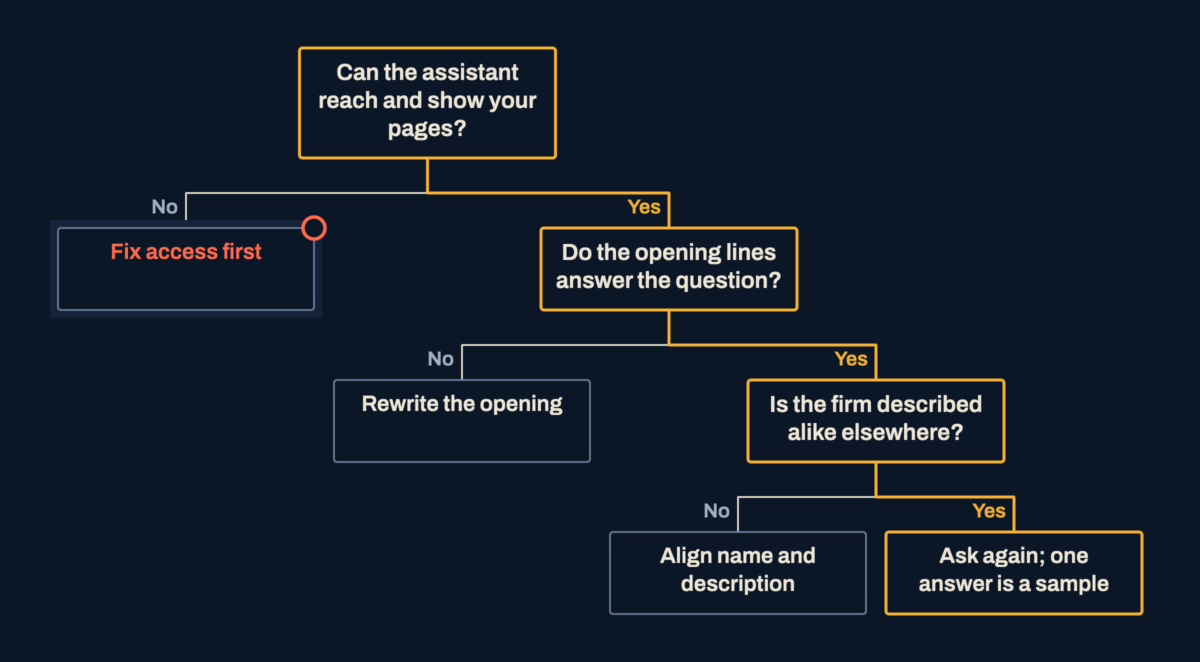
The diagram below gives the order we use. It starts with access, because that part is documented and certain to fix: a blocked crawler, or a page not eligible to be shown, ends the inquiry. Next comes the opening of the page, which is cheap to change and easy to test. Only then does it turn to the harder job of making the firm describable the same way across its own pages and other people's.
Run each test on more than one day and with more than one assistant before you conclude anything. Google notes that its AI Overviews and AI Mode can draw on different models, so the links each shows can differ, and it's sensible to assume the same between vendors.
The order in which to look for the gap
Read this as text
The tree starts with a question: can the assistant reach and show your pages? If no, the outcome, marked in red, is to fix access first. If yes, the next question is whether the opening lines answer the question. If no, the outcome is to rewrite the opening. If yes, the last question is whether the firm is described alike elsewhere. If no, the outcome is to align name and description. If yes, the outcome, drawn in blue, is to ask again, because one answer is a sample.
What if the recommendation never came from your pages?
Then none of the above applies, and nothing the vendors document says how often it happens. Anthropic's documentation says Claude answers directly, without searching, when a request draws on stable knowledge, and OpenAI's guide says the model chooses whether to search. An answer given without a search names firms from the model's own recall. OpenAI also states that each crawler setting is independent, so a site can allow its search crawler and disallow its training crawler. The pages we read don't say whether training access changes what a model recalls about a firm, and we don't claim it either way.
So don't conclude too much from one answer, and don't copy the competitor's page. Firms that share a description are harder for a reader to tell apart, not easier.
What does this rest on?
Vendor documents, read on 23 October 2026, with the date each shows where there is one, and our experience of how firms describe themselves. We tested no assistant for this piece, and the checks are inference. Nothing here says how often a firm is named or what any assistant would answer for yours.
- Google, AI features and your website (Search Central page, updated 10 December 2025): what makes a page eligible as a supporting link, and the statement that no special markup is needed
- Google Search Central, Control your snippets in search results (last updated 20 April 2026): how snippets are created from page content
- Google Search Central, Organization structured data (last updated 8 September 2026): disambiguating an organization, and the sameAs property
- Google Search Central, Creating helpful, reliable, people-first content (last updated 5 October 2026): clear sourcing and whether a site is well trusted
- OpenAI, Overview of OpenAI crawlers (undated): OAI-SearchBot, opted-out sites and independent crawler settings
- OpenAI, Web search guide (undated): the model chooses whether to search, and opening a page and finding text in it are separate actions
- Anthropic Help Center, article on Anthropic's web crawlers (7 April 2026): Claude-SearchBot and visibility
- Anthropic, Web search tool (undated): answering directly, without searching, from stable knowledge
- Perplexity, Perplexity crawlers (undated): PerplexityBot, designed to surface and link websites
Use this
Take your most important service page and rewrite its opening so it answers one buyer question outright. Then ask an assistant that question again and compare.
Related
Not sure how an assistant would describe you?
Send us the address of the service page you would want an assistant to quote first. A senior person reads it and writes back on what we would change first.