The Field Report
The process that waits for one person to come back
The request is ready, the form is complete and everyone agrees. It will move when she's back. Nobody has asked what she does to it that nobody else can.
- Author
- Amit GovilFounder and CEO, XONIK
- Published
- October 22, 2026
- Reading time
- 8 min read
In this piece
Voice and options
Read aloud by the voice on your device. Nothing is sent to us.
In brief
A process waits for one person when she holds a step the process never names: a test, an exception or a route. While she's away, work queues, then gets guessed at, then is redone when she returns. The dependency forms through quick favors and nobody deciding it, and it shows in the work well before the absence.
Key findings
Nobody decides the dependency, and each turn of the loop is a sensible response to the one before.
The person who resolves awkward requests fastest gets all of them, so nobody else meets the cases or learns what she knows. The knowledge stays unwritten because, from the inside, the step doesn't feel like a step.
The unnamed step is a test, an exception or a route, and each is recovered differently.
You can add a test to the form, list an exception with its reason and its owner, and draw a route as a directory. None of them survives staying in one head.
While she's away the work is held, not failed, so nobody sees a failure.
Her cover can't tell the complete, correct requests from the rest, and a pending item reports no error. When she returns, the held work lands in a day, and any decision made by guessing the rule has to be found and checked.
The delay is what people see. The larger costs are the business's freedom to change and her time off.
A redesign built from the written map is faster and wrong in exactly the cases she used to catch. And a step done by one person is never checked by another.
Make each hidden step explicit, and rehearse the absence while she's still reachable.
It goes better when you ask her to lend her judgment than when you ask her to document herself. Some judgment won't reduce to a rule, and for that the aim is a second person who has made the decision often enough to be trusted.
Nobody decided this, and that is how it forms
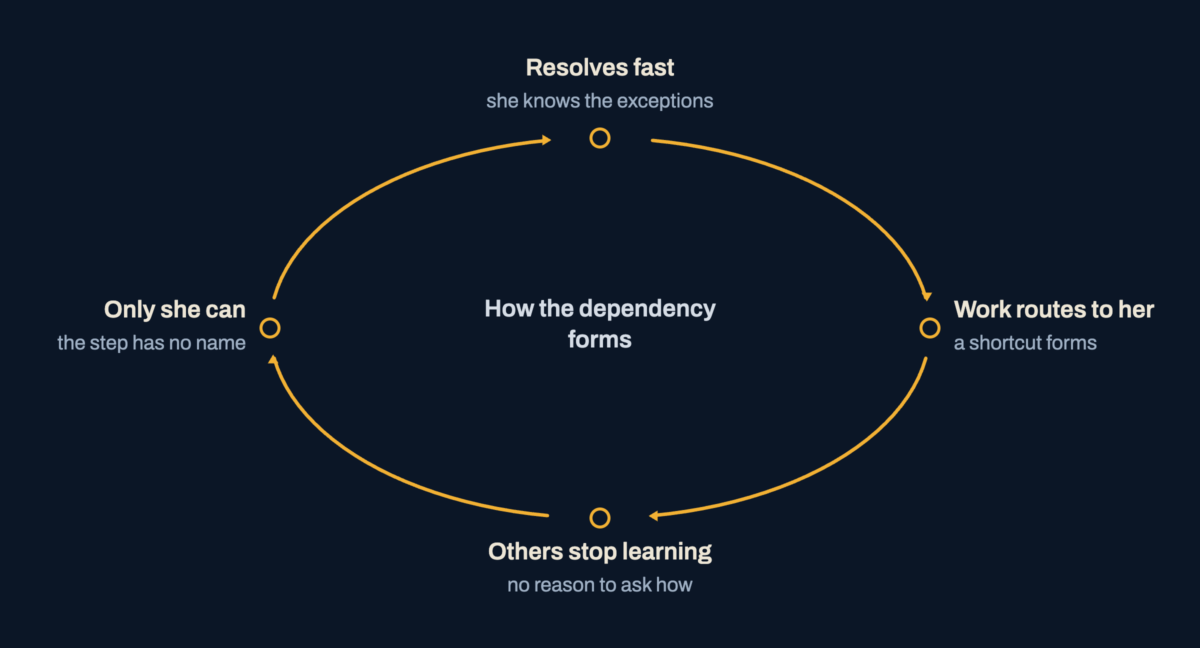
Ask how it started and you'll hear about a favor. Someone in the process resolves awkward requests faster than anyone else, because she's met them before. The people sending requests learn that the quickest route runs through her, and they take it. Now the awkward cases all land on one desk, so nobody else meets them and nobody else learns what she knows. After a while the step she performs has no name and no second performer. Exhibit 1 shows the loop. Each turn of it is a sensible response to the turn before, which is why nobody questions it.
The knowledge stays unwritten for reasons that have nothing to do with carelessness. From the inside, the step doesn't feel like a step. It feels like reading a request properly, and a person can't easily list what they do by habit. Writing it down takes time from work that's already waiting. And a document has no reader until the day it's needed, so there's never a moment when writing it looks more urgent than the queue.
Exhibit 1
How a dependency on one person forms
Text description of this exhibit
The picture is a closed loop drawn clockwise from the top, with the title how the dependency forms in the center. The first stage is resolves fast, with the note she knows the exceptions. The second is work routes to her, with the note a shortcut forms. The third is others stop learning, with the note no reason to ask how. The fourth is only she can, with the note the step has no name, and its arrow returns to the first stage. Every arrow is blue and none is broken.
A test, an exception and a route can each be written down. None of them survives staying in one head.
While she's away, the work waits and nobody sees it fail
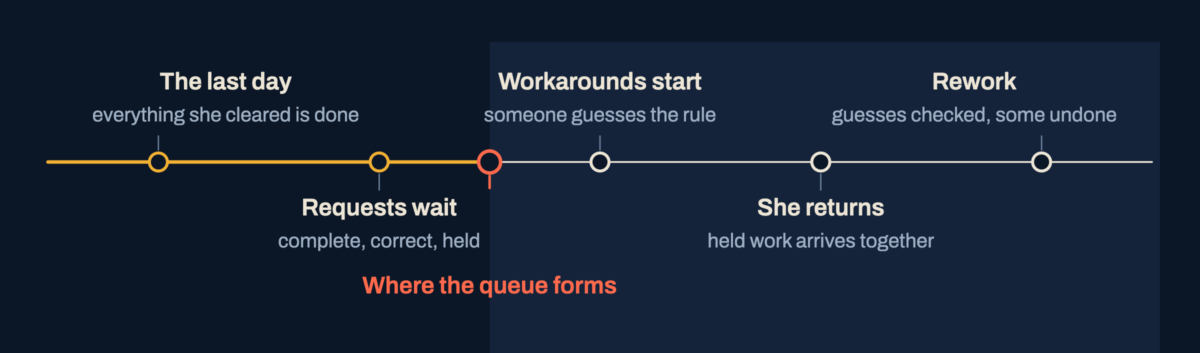
Take a composite: a retailer's finance function in which one person resolves supplier invoices that don't match their orders. She knows which mismatches are only timing, which are errors, and which suppliers always invoice a particular way. While she's away, her cover reads the written policy, which says mismatches go to the buyer. That's correct and useless, because the buyer doesn't know either. Exhibit 2 follows what happens next.
Requests that are complete and correct get held, because the cover can't tell them from the ones that aren't. Nobody sees a failure. Every item is simply pending, and a pending item reports no error. Some of the cover's colleagues, pressed by suppliers, decide by guessing the rule. When she returns, the held work arrives in a single day, and the guessed decisions have to be found and checked. The delay is only part of the cost. The queue she comes back to makes the next absence harder, and decisions were taken on rules nobody could state.
Exhibit 2
What a queue does during an absence
Text description of this exhibit
A line runs left to right through a series of events. The first is the last day, with the note everything she cleared is done. The second is requests wait, with the note complete, correct, held. Immediately after it a red marker labeled where the queue forms divides the line, and the area after it is shaded. The next event is workarounds start, with the note someone guesses the rule. Then she returns, with the note held work arrives together. The last is rework, with the note guesses checked, some undone.
The delay is the smaller cost
The delay is what people see. The larger costs sit underneath it. The first falls on the business's ability to change. A team that redesigns or automates the process works from the written map, and the written map leaves out the hidden step. The new version is faster and wrong in exactly the cases she used to catch, and she's the one who finds out, back from leave. The second falls on her. Someone who knows nobody else can do the step never fully leaves: she answers messages on time off and carries a duty the organization has never acknowledged. That's a poor return for being useful.
The third falls on the quality of decisions. A step taken by one person is never checked by another, so the rule she applies is never questioned, even after it stops being right. A step that more than one person can perform has, by that fact alone, been read by a second mind.
How do you see the dependency before she is away?
It shows in the work. Look for requests whose comment thread holds one name and nothing else. Look for exception lists kept in a personal spreadsheet or a mail folder. Listen for "ask her" as the answer to a question in team chat. Look at a process map for a box labeled review or check that gives no criteria. Compare how long a step takes when she does it with how long it takes when anyone else does.
Then run the test that settles it. When the next awkward request arrives, ask the person who'd be her cover to make the decision while she watches and says nothing unless asked. Write down every question the cover asks. Each question is a hidden step, stated by the one person who needs it stated. The test works because the cover doesn't know what to leave out.
Careful planning already assumes this. NIST Special Publication 800-53, in control PS-4 on personnel termination, asks an organization to retain access to the information and systems formerly controlled by the individual, and its guidance notes that an exit interview may not always be possible, for reasons that include illness. The control is written about people who leave the organization, but the lesson carries over: the plan doesn't rely on the conversation taking place. Neither should a process.
What changes it?
Make each hidden step explicit, in the form that suits it. Put the test on the request form as a question the sender must answer. Keep the exceptions in one shared list, each with its reason, its owner and the date it was last checked. Publish the routes as a directory with a first and a second contact. These are small changes, and the work of making them is mainly listening to her, so it goes better when she's asked to lend her judgment than when she's asked to document herself.
Be plain with her about the purpose. If the request sounds like preparation for replacing her, the answers will be guarded and short. If it sounds like what it is, a recognition that the organization has been leaning on her without choosing to, the answers are specific and often generous. Credit the knowledge by name when it's written down, and give her the first review of what's recorded, since she's the one who'll notice what's wrong.
Then rehearse the absence. Pick a quiet period in which the cover runs the step without consulting her, and review afterward what was decided and what was held. A rehearsal finds the gap while she's still reachable. Some judgment will remain that can't be reduced to a rule. For that, the aim is a second person who has made the decision often enough to be trusted with it, and no document will do that for you.
What does this rest on?
This is observation from process and systems work, offered as a method and not as a measured result. We read the one external document on 23 October 2026. The piece doesn't say how common the dependency is.
Use this
Pick one request that is waiting for a particular person today. When she's back, ask what she did to it that nobody else could have, and write the answer down together.
Related
Is a process of yours waiting on one person?
Tell us which process stops when a certain person is out, and what happened the last time. A senior person reads it and replies with how we would start looking for the hidden step.