The Field Report
The decision that comes back every quarter
It is on this quarter's agenda again, with a fresh slide deck. The decision was made and minuted, and nobody in the room can say who gets to declare it settled.
- Author
- Amit GovilFounder and CEO, XONIK
- Published
- October 22, 2026
- Reading time
- 7 min read
In this piece
Voice and options
Read aloud by the voice on your device. Nothing is sent to us.
In brief
Settled decisions come back because nobody holds the authority to close them, and the reasons behind them don't have to be weak. Reopening costs a slide deck, while closing costs the person who rules. A decision stays shut when a named person rules, the dissent is heard and recorded, and the conditions for reopening are written down.
Key findings
A decision taken by consensus is closed only by consensus, and consensus can be rebuilt any day.
Everyone holds an equal right to reopen it and nobody holds the right to refuse. Some returns are legitimate, because a fact the decision assumed has changed, and those show the system working.
A decision that keeps returning teaches the organization to treat decisions as proposals.
The units told to migrate hold off, the platform team can't commit to a plan, and the next decision, which may matter more, gets waited out in the same way.
Whoever carries the consequences holds the authority to close.
Others with a stake have a different right: to be heard before the ruling and to have their objection written down. They don't vote, because a vote is what lets the question be rebuilt.
A ruling needs its reasons, what would change it, and a review date.
A decider who rules without reasons is no better than a room that can't decide, because the next doubt has nothing to answer it. A closing note after the first meeting would have answered the later returns in a sentence each.
Closing a decision gives dissent a channel instead of silencing it.
The channel is a request to the decider that names what has changed, answered in writing. A return that brings no new fact leads to a single task: name someone who can say the matter is closed.
Why does a settled decision keep coming back?
Asking again is cheap and answering is expensive. Anyone in a leadership group can put an item back on the agenda at the cost of a slide deck. Closing it costs the person who does it: they overrule colleagues, absorb the displeasure and own the result if it goes badly. Among peers nobody is paid to do that, so nobody does, and the decision stays pending whatever the minutes say.
A decision taken by consensus is closed only by consensus, and consensus can be rebuilt on any day by a new argument or a new member. Each person holds an equal right to reopen it, and nobody holds the right to refuse. That is why the return is so regular. The reasons may be excellent, and the gap is somewhere else.
Some returns are legitimate, because a fact the decision assumed has changed. That is the system working. The harder question is what to do with the returns that bring no new fact, and the answer starts with who is able to close them.
A composite: the platform decision that wouldn't stay shut
This is a composite, not one company. A leadership team decides that its business units will stop buying separate AI tools and move onto one shared platform. The reasons are sound: one set of controls, one supplier to oversee, one place for the data to sit. The decision is taken in a good meeting and recorded in a line.
The next quarter, a unit whose tool was set aside returns with results from its own trial and asks for an exception. The chair, a peer of the unit's head, thinks it fair to hear them out. The group goes back over the original options and decides it needs more evidence. The quarter after, the head of another unit, new to the job, reasonably asks why the decision was made. Nobody has the reasons to hand. Then the supplier changes its terms, which may or may not matter, since the decision never said what it assumed. Each return is polite, and each is reasonable by itself. Exhibit 1 shows the cycle.
Exhibit 1
A decision with no one able to rule on it
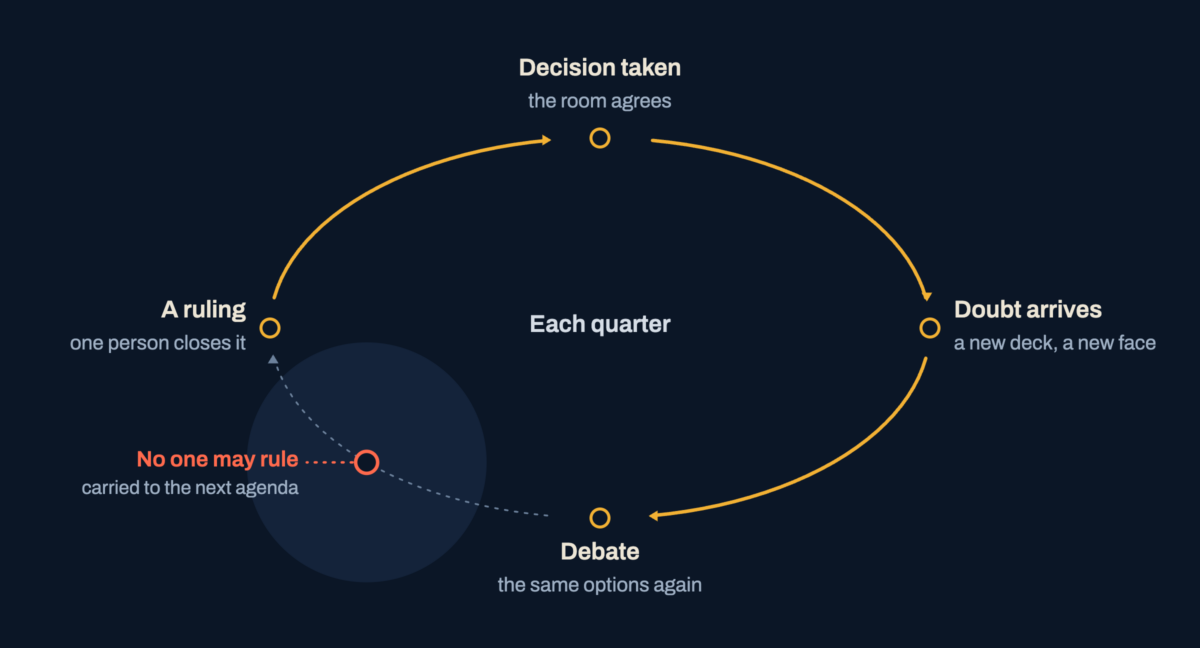
Text description of this exhibit
A cycle labeled Each quarter, with stages clockwise from the top. Decision taken: the room agrees. Doubt arrives: a new deck, a new face. Debate: the same options again. A ruling: one person closes it. The arcs are blue up to the debate. The arc from debate to a ruling is broken, and a terracotta mark on it reads No one may rule, carried to the next agenda. A pale shaded circle surrounds the mark.
What does a returning decision cost?
The hour of leadership time each quarter is the visible cost. The bigger one is in behavior. Units told to migrate wait, because experience says the decision may be reversed. The platform team can't commit to a plan. The unit with the set-aside tool keeps spending. A decision that returns teaches the organization to treat decisions as proposals, and the next one, which may matter more, gets waited out in the same way.
A returning decision needs someone whose job is to say that it stands.
Who should hold the authority to close it?
The person who will carry the consequences and has the standing to do it, usually the executive accountable for the outcome the decision serves. In the platform example that is whoever answers for the cost and controls of the AI estate, not the chair of the meeting and not the unit that lost. Others with a stake, such as risk, technology and the units, hold a different right: to be heard before the ruling and to have their objection written down. They don't vote, because a vote is what lets the question be rebuilt.
The decider owes the group something back. The ruling comes with reasons anyone can read, a statement of what would change it, and a date when the decision gets looked at again whether or not anybody asks. A decider who rules without reasons is no better than a room that can't decide, because the next doubt has nothing to answer it. In the platform example, a closing note after the first meeting would have answered the second and third returns in a sentence each.
What does closing a decision look like?
Closing has a person in it. For each class of decision, the group names in advance who decides after hearing the others: a role and a name, not the group. The group advises and the decider rules. A chair who is a peer of the others can't do this. And a decider the next meeting can overrule isn't one, so only someone senior to them can override a ruling, and only in writing.
Record the ruling so that someone joining the group can read it in one sitting. Michael Nygard's note on documenting architecture decisions, published in 2011 for software projects, describes a form that works: a title, the context and forces at play, the decision in full sentences, its status, and its consequences, all of them and not only the favorable ones. When a decision is reversed, the old record is kept and marked as superseded, because it still matters to know it was the decision. His reason for keeping records applies to any group: a person arriving later can otherwise only accept a decision blindly or change it blindly.
A leadership group needs additions. Write the dissenting views in their holders' own terms, so the losing side can see they were heard. And state what would reopen the decision: a named assumption changing, a stated result, a date for review. Then closing is a state you can check, and the list below is the check.
Is this decision closed?
- One named person with authority ruled, and the record says who
- The options set aside are listed, each with its reason
- People who disagreed are recorded in their own words
- The facts the decision rests on are written down, with someone named to watch each
- The conditions that would reopen it are stated, with a review date
- The route for reopening is written: a request to the decider that names the changed fact
- A person new to the group can read all of it in one sitting
How do you tell a good return from a bad one?
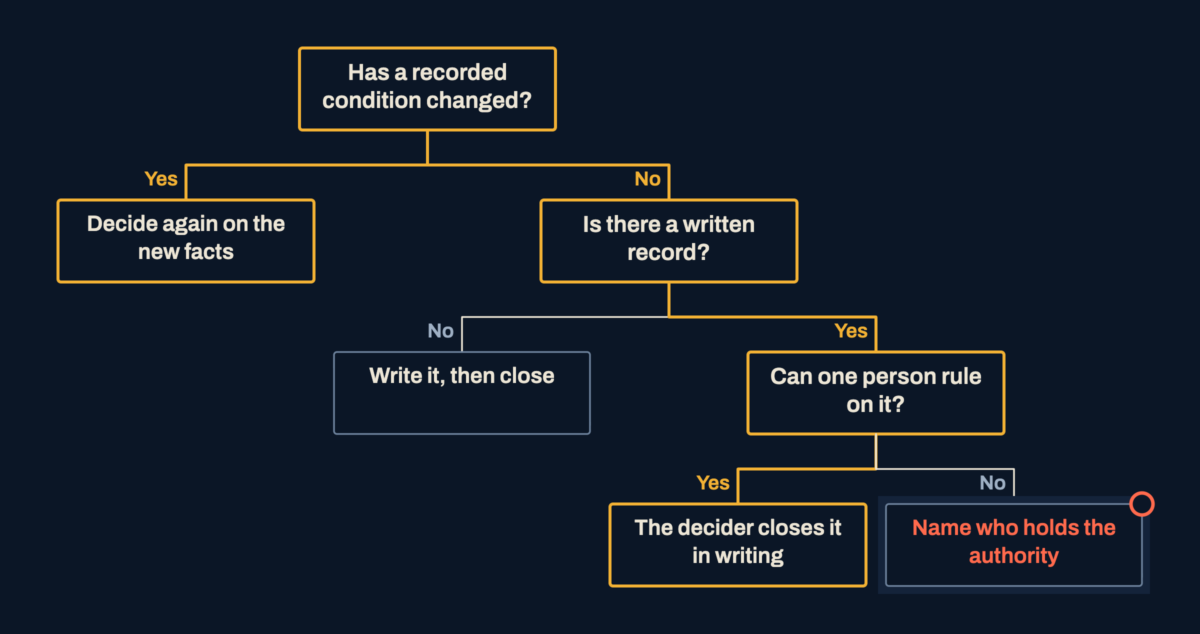
When a decision comes back, ask the questions in Exhibit 2, in order. If a recorded condition has changed, the return is legitimate, and the right response is to decide again on the new facts. If nothing has changed, ask whether a record exists. Without one, no doubt can be answered, so write it before anyone debates, and close the item with the writing. With a record and no changed condition, the question is whether anyone can rule. If the decider exists, they close it in writing, without a meeting. If nobody can, the finding this quarter has little to do with the original question: no one holds the authority, and the useful decision is to name who does.
Exhibit 2
What to ask when a decision returns
Text description of this exhibit
The first question is whether a recorded condition has changed. Yes leads to deciding again on the new facts, drawn in blue. No leads to the second question: is there a written record? No leads to writing it, then closing. Yes leads to the third question: can one person rule on it? Yes leads to the decider closing it in writing, drawn in blue. No leads to naming who holds the authority, marked in terracotta and shaded.
Does closing a decision silence dissent?
No. A decision nobody can reopen is as unsound as one anyone can reopen at will. Dissent gets a channel with a rule: a request to the decider that names what has changed, answered in writing, plus a review date that arrives whether or not anyone is pressing for it. The NIST AI Risk Management Framework 1.0 asks for a similar discipline in risk management, with ongoing monitoring and periodic review planned, roles defined and the frequency of review determined (GOVERN 1.5).
We haven't measured this. It comes from advisory work, and we offer it as a habit to try, starting with the decision your team has now discussed more often than it deserves.
Sources
We read both on 23 October 2026. The leadership team described is a composite of patterns from advisory work, not an account of any one company.
Use this
Pick the decision that keeps returning. Before the next meeting, write its record, with the conditions that would reopen it and the name of the person who can close it.
Related
Is there a decision your team keeps reopening?
Tell us which decision keeps returning and who sits around the table when it does. Someone senior reads it and replies with who we think should hold the ruling.